SEVEN GATES DAILY BRIEF
Emergency diesel cannot reverse the food-price shock
The G7 starts another coordinated fuel release, world food prices rise, Nigerian households grow more pessimistic, Vietnam accelerates, and AI enters everyday financial decisions.
A coordinated diesel release can reduce the cost of moving food. It cannot restore a lost harvest or remove restrictions on grain shipments. This weekend’s evidence puts those limits in view: governments are mobilising fuel stocks while international cereal prices rise and Nigerian households report worsening finances. The immediate question is how much relief reaches transport operators, food producers and consumers.
1. The G7 commits fuel stocks, with an important accounting caveat
The 2 October G7 statement promises a coordinated 100-million-barrel release over four months, including substantial diesel volumes within the first 20 days. It also proposes coordinating refinery maintenance and increasing utilisation where feasible. That targets the shortage of usable products more directly than a crude-only announcement.
The IEA says roughly 325 million of the 400 million barrels pledged in March have already been released. The new statement refers to fulfilling commitments after allowing for earlier deliveries. Do not automatically add 100 million to the March total: the precise overlap needs clarification.
Nigeria could benefit through lower diesel, freight and agricultural distribution costs. Refiners could face narrower product margins. Neither effect is immediate or assured; delivered volumes, fuel specification and destination determine whether the intervention changes local prices. Emergency stocks provide temporary supply while navigation and refining remain impaired.
Sources: G7 leaders, 2 October · IEA briefing, 2 October.
2. Food prices rise unevenly, with cereals under pressure
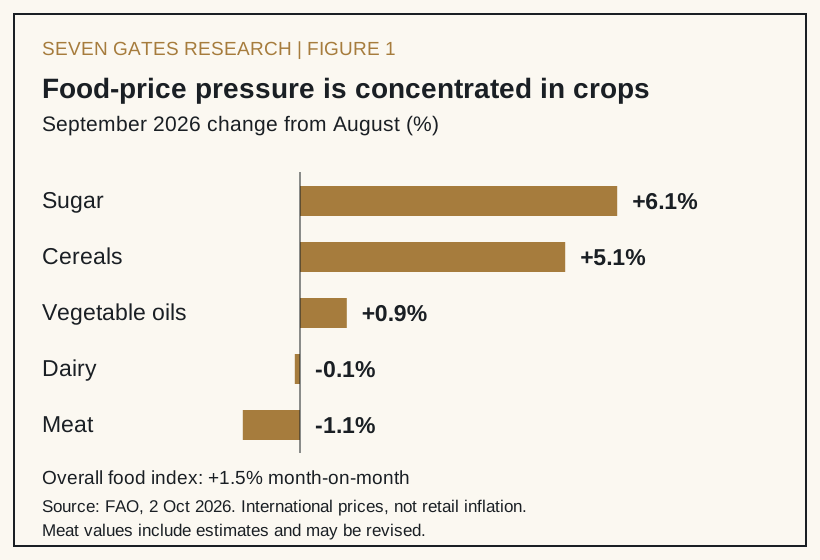
FAO’s September food index reached 136.0, up 1.5% from August and 5.8% over the year. Cereals rose 5.1% during the month; sugar increased 6.1%. Meat declined 1.1%, while dairy edged down 0.1%. The chart shows why one aggregate can conceal sharply different procurement conditions.
FAO identifies Black Sea logistical constraints, weather and tighter maize availability among the pressures. These are international commodity quotations, not a forecast of Nigerian retail inflation.
For Nigerian millers, poultry producers and households, exchange rates and shipping costs govern the eventual impact. Domestic substitutes can help, but substitution also changes demand for locally grown crops. Monitor landed wheat and feed costs alongside the harvest. A lower fuel bill would help distribution without necessarily offsetting dearer ingredients.
Source: FAO, September release, 2 October.
3. Nigeria’s businesses improve while households retreat
September’s CBN composite purchasing managers’ index rose to 53.0 from 52.7, according to reports published on 2 and 3 October. Readings above 50 indicate expansion. Yet the household consumer-sentiment measure fell to minus 18.7 from minus 9.9, Premium Times reports from the separate CBN survey.
These surveys measure different respondents and concepts. PMI is not a GDP growth rate, and household sentiment is not measured spending. Together they suggest that improved activity has yet to produce a convincing household recovery.
For consumer-facing companies, volume, affordable pack sizes, receivables and gross margins deserve more attention than nominal sales growth. For policymakers, evidence of expanding production should sit beside evidence of strained purchasing power. Both can be accurate. The primary survey files were not retrievable in this check; these figures remain attributed to the linked reporting.
Sources: Nairametrics, CBN PMI, 2 October · Premium Times, both surveys, 3 October.
4. Vietnam accelerates, with a trade deficit alongside growth
Vietnam’s official announcement puts third-quarter GDP growth at 9.95% year-on-year, following 8.15% and 8.81% in the first two quarters. Realised foreign direct investment reached $21.07 billion over nine months. Imports also grew faster than exports, producing a $19.42 billion goods deficit.
That qualifies the export-boom headline. Fast industrial expansion can require imported machinery and components, creating near-term foreign-exchange demand. Nigeria’s relevant lesson is operational: examine realised investment, productive capacity and the import requirement together. Announced investment alone proves little about output or external resilience.
Source: Vietnam Government News, statistical release, 3 October.
5. AI expands its consumer-finance reach
OpenAI’s 2 October release notes say connected-account finance tools are rolling out to Free and Go users in the United States. This broadens access to personalised spending and investment explanations; it does not establish Nigerian availability or independently verified financial benefits.
The commercial implication is competition for the interface through which customers understand their money. Banks and fintechs should test whether AI explanations improve comprehension and decisions, while measuring errors and preserving clear consent. More users and more account data will make accuracy consequential well beyond a product demonstration.
Source: OpenAI release notes, 2 October.
Three numbers worth remembering
- 100 million barrels: G7’s coordinated four-month release commitment.
- 5.1%: September’s monthly rise in international cereal prices.
- Minus 18.7: Nigeria’s reported household consumer-sentiment index.
What could change everything?
Actual frontloaded diesel deliveries and durable shipping access would ease supply pressure. For Nigeria, falling landed food costs combined with improving household demand would offer stronger evidence of relief than another positive activity survey. Watch implementation and purchasing power together.
Prepared for 4 October 2026 from sources dated 2–3 October. Survey reporting is explicitly attributed; transmission mechanisms and judgements are Seven Gates analysis.