SEVEN GATES DAILY BRIEF
Nigeria mourns 32; Bab el-Mandeb changes hands
A military aircraft crash demands answers at home, Yemen's coast has changed hands, French debt risk is moving the euro, and Congo's Ebola emergency is still expanding.
Nigeria begins today in mourning. Thirty-two people died when a Nigerian Air Force aircraft crashed in Ondo State. There is no useful market metaphor for that. The immediate duties are to identify the dead, support their families, preserve evidence and establish why a routine flight did not arrive. Beyond Nigeria, forces backed by Saudi Arabia say they have retaken the Yemeni coast beside Bab el-Mandeb, while the Houthis retain the ability to strike ships and infrastructure. One maritime risk may have narrowed; none has disappeared.
1. Nigeria has lost 32 people, and now needs an independent chain of facts
The Presidency said on 5 October that a Nigerian Air Force ATR-42 carrying 25 passengers and seven crew crashed near Igbokoda while flying from Benin to Lagos. There were no survivors. President Bola Tinubu declared three days of mourning, ordered flags flown at half-mast and directed the Air Force to investigate.
The mourning is national; the investigation must be technical. The eventual report should state the aircraft's maintenance record, crew duty history, weather, communications, flight-data evidence and the corrective actions assigned to named institutions. Nigeria has promised an inquiry. Public confidence will depend on whether it produces a publishable causal chain rather than a ceremonial conclusion.
Sources: State House, 5 October · Reuters, 5 October.
2. Bab el-Mandeb has changed hands, but not risk
Saudi-backed Yemeni forces said on 5 October that they had retaken the coast around Bab el-Mandeb up to Mocha. Reuters could not independently verify the full advance. Houthi forces disputed the claims and reported attacks on Saudi airports and oil facilities; those claims were also unverified. The UN migration agency said 184,000 people have been displaced since the war resumed.
Control of coastline matters because Bab el-Mandeb connects the Red Sea to the Gulf of Aden. Yet coastal possession does not remove drones, missiles or mines from the equation. Shipping insurers will price demonstrated safety, not a flag on a map. Nigeria's transmission runs through diesel, fertiliser, freight and food: cheaper crude helps only if refined-product routes become reliably safer.
Source: Reuters, 5 October.
3. France's fiscal argument is now travelling through currencies
The euro touched $1.116 on 5 October, its weakest level in 17 months. The spread between French and German 10-year bonds had reached nearly 160 basis points on Friday, the widest since the euro-area sovereign-debt crisis, before narrowing. France is not Greece in 2011, but the market is testing whether a large member can deliver restraint before an election.
This matters beyond Europe. A stronger dollar increases pressure on dollar borrowers and can tighten global financial conditions even when the Federal Reserve pauses. For Nigeria, that can mean dearer Eurobond refinancing and a less forgiving external market. The relevant signal is not one day's euro quote; it is whether French spreads remain elevated through the budget process.
Sources: Reuters, 5 October · European Commission forecast, 21 May.
4. Congo's Ebola emergency is still getting larger
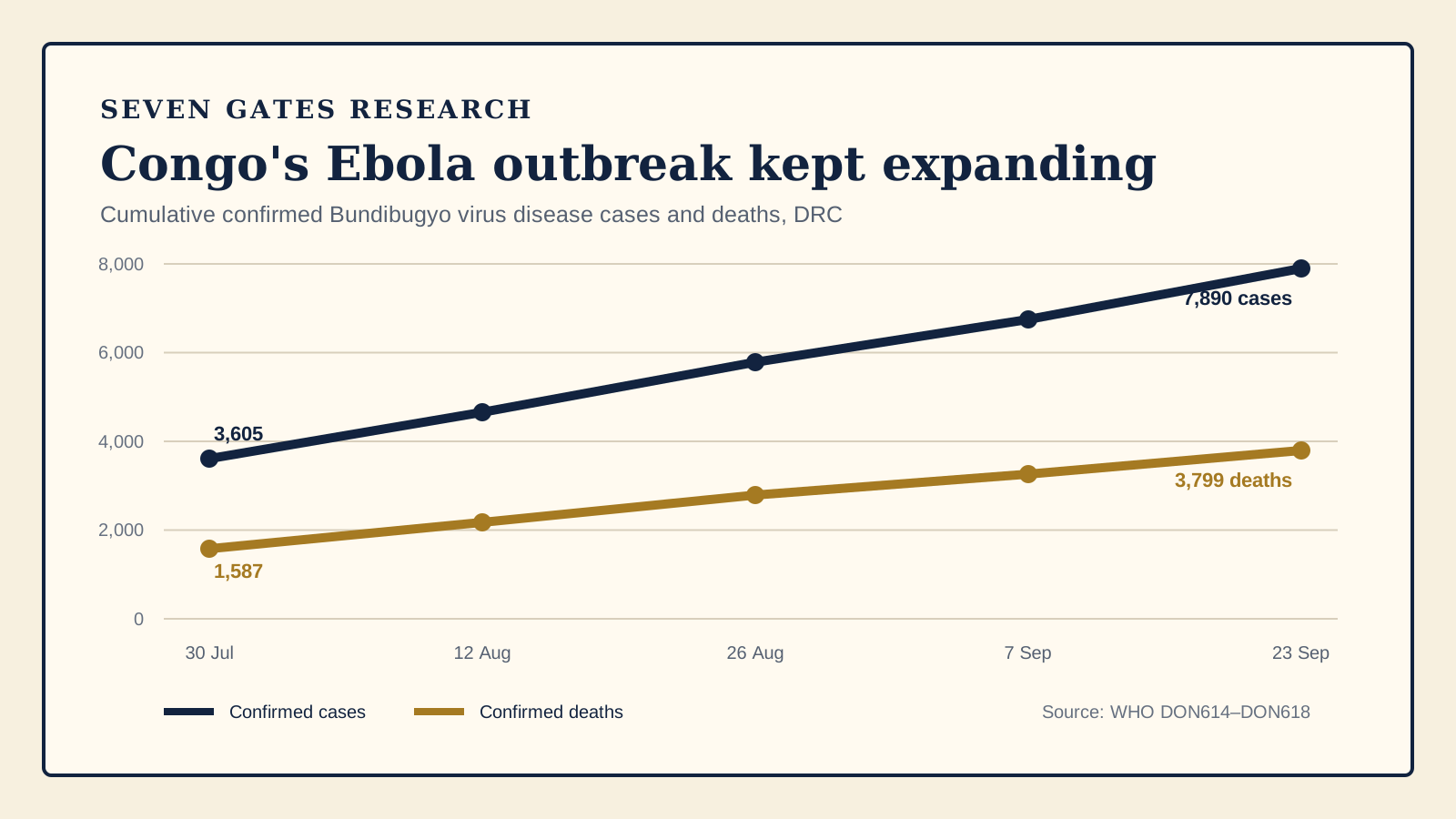
The latest comparable WHO bulletin records 7,890 confirmed cases and 3,799 deaths in the Democratic Republic of the Congo as of 23 September, across 63 health zones in seven provinces. The chart shows the cumulative rise from 30 July. WHO assessed national risk as very high and risk to neighbouring countries as high; it still advised against travel or trade restrictions.
The economic question comes after the human one. Conflict, displacement and weak access are obstructing surveillance, contact tracing and care. Nigeria is not a bordering state, but air links and regional mobility make readiness sensible: case definitions, isolation capacity, protective equipment and trusted public communication should be checked before an imported case, not after it.
Source: WHO Disease Outbreak News, 25 September.
5. Washington and Tokyo are turning AI policy into industrial alignment
The United States and Japan reported on 5 October that they had extended their 1988 science agreement indefinitely, launched 11 joint teams under a $1 billion research partnership and committed to closer work on AI standards, robotics, 6G, quantum technology, biotechnology and pharmaceutical supply chains. Each also intends to commit $20 million to trusted AI adoption across the Indo-Pacific.
This is technology policy with procurement, laboratories and standards attached. Nigeria's lesson is practical: AI strategy needs compute access, research institutions, export positioning and rules that buyers recognise. A declaration without those delivery mechanisms is publicity, not industrial policy.
Sources: US-Japan joint statement, 5 October · White House agreement, 28 October 2025.
Three numbers worth remembering
- 32: passengers and crew killed in the Nigerian Air Force crash.
- 184,000: people displaced since fighting resumed in Yemen, according to the UN migration agency.
- 48.1%: confirmed case-fatality ratio in Congo's latest comparable WHO Ebola bulletin.
What could change everything?
A transparent crash report would convert grief into prevention. Verified safe passage through Bab el-Mandeb, alongside progress at Hormuz, would change the energy ledger. A sustained rise in French spreads would turn a national budget dispute into a wider funding problem. In Congo, falling new cases across successive reporting periods, rather than a single quieter week, would be the first durable relief.
Prepared for 6 October 2026 from sources published or updated through 5 October. Claims by governments and armed parties are attributed; transmission mechanisms and judgements are Seven Gates analysis.