SEVEN GATES DAILY BRIEF
Weaker hiring offers little protection from a wider war
US hiring slows, Saudi Arabia reportedly prepares a Yemen offensive, gas cargoes cross Hormuz, Nigeria reports higher domestic supply, and AI investment faces a harder utilisation test.
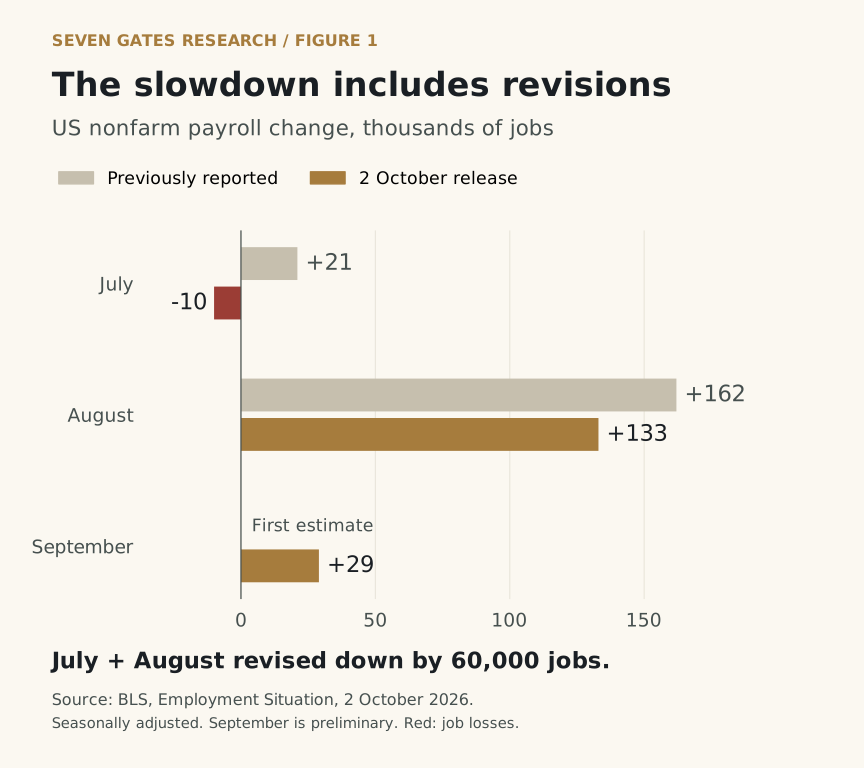
September added 29,000 American jobs. Revisions removed 60,000 from the preceding two months. That gives central bankers a reason for patience just as reported preparations for another offensive in Yemen threaten to make energy more expensive. Slower demand and disrupted supply require different remedies. One interest-rate decision must accommodate both.
1. US hiring weakens, with an uneven human cost
Friday’s Bureau of Labor Statistics release put unemployment at 4.2% and September payroll growth at 29,000. July now shows a 10,000 decline; August’s gain was revised to 133,000. Average hourly earnings rose 3% over the year. Black unemployment increased to 7%, against 3.6% for white workers, a reminder that the aggregate conceals very different experiences.
The report strengthens the case for caution on further tightening. It does not establish a recession: unemployment remains within its recent narrow range, and monthly payroll estimates are noisy. Nor can weaker recruitment make shipping safer.
For Nigeria, less US tightening would ease one source of pressure on dollar funding and portfolio flows. It would not guarantee a stronger naira. Export receipts, domestic inflation and the return offered on naira assets still determine whether investors stay.
Source: BLS, September employment report, 2 October.
2. Saudi Arabia reportedly prepares another Yemen offensive
Reuters reports that Riyadh is preparing a Saudi-supported Yemeni ground offensive, considering either a coastal operation around Bab el-Mandeb or attacks across several fronts. Its sources gave widely differing possible start dates. The Saudi and Yemeni governments had not responded to requests for comment. These are reported preparations, not a confirmed launch.
Securing the southern Red Sea passage could eventually improve shipping access. Fighting to achieve that could first endanger civilians, vessels and infrastructure. Saudi exports routed through Yanbu also depend on destination: southbound voyages face Bab el-Mandeb, while northbound access uses Suez. A Hormuz bypass does not remove every maritime exposure.
Nigeria’s potential benefit from stronger crude prices must therefore be weighed against freight, insurance and fuel costs. Treat any immediate oil-price gain as conditional revenue, not a durable national windfall.
Source: Reuters via Military Times, 2 October.
3. More LNG is crossing Hormuz, with uncertain visibility
September LNG transits reached their highest monthly level since the war began, Reuters reports. S&P Global Energy counted 19 shipments; Kpler counted 21. Some vessels reportedly travelled with tracking transmissions switched off.
Keep both estimates visible. Different tracking coverage is consequential when ships deliberately disappear from public systems. More completed voyages could ease winter supply pressure, but they do not establish reliable, insurable access. Buyers need repeatable deliveries before they can confidently reduce precautionary stocks. Nigerian LNG producers can benefit from supply diversification only if feedgas and plant availability permit additional cargoes.
Source: Reuters via Economic Times, LNG estimates, 2 October.
4. Nigeria’s gas improvement needs a customer-side test
Gas minister Ekperikpe Ekpo says domestic supply has exceeded 2 billion cubic feet a day, with overall production around 7.5 billion. He also says the completed OB3 pipeline is preparing for first gas. These are ministerial figures reported on Friday, not an independently audited delivery series.
The useful follow-up is gas reaching paying customers. Additional supply can displace diesel, support fertiliser production and improve electricity generation. Those gains still require transport availability, power dispatch and collections. Investors should ask for metered deliveries and payment performance alongside production totals. A completed pipeline awaiting gas has yet to prove its contribution to industrial output.
Source: Naija247news, Ekpo’s briefing, 2 October.
5. AI economics increasingly depend on utilisation
Nvidia’s 1 October investment argument puts AI-factory cost at roughly $60 million per megawatt and stresses earning capacity, useful life and demand. This is a supplier’s estimate and commercial case, not an independent industry benchmark.
The framework is useful nevertheless. Faster chips create value only when customers buy enough computation at adequate margins. Longer hardware life improves returns only while equipment remains economical to operate. Scrutinise contracted demand, electricity availability and cash returns before extrapolating equipment orders into lasting profits. Capacity is comparatively easy to announce.
Source: Nvidia, AI-factory economics, 1 October.
Three numbers worth remembering
- 29,000: September’s first US payroll estimate.
- 60,000: jobs removed from July and August by revisions.
- Above 2 billion cubic feet/day: Nigeria’s reported domestic gas supply.
What could change everything?
Watch for a confirmed Yemen operation or a negotiated navigation arrangement, followed by evidence of sustained commercial transits. In Nigeria, the decisive gas update is first delivery through new infrastructure and dependable payment. Those developments would change physical supply and operating costs more directly than another announcement of ambition.
Prepared for 3 October 2026 using releases and reporting through 2 October. Shipping estimates and military plans remain uncertain; economic transmission and judgements are Seven Gates analysis.