SEVEN GATES DAILY BRIEF
Seven conditions stand between Hormuz and reopening
Iran has made reopening conditional, Ethiopia's Tigray war has reached Mekelle, Brazil is heading to a close runoff, and France's debt pressure is weakening the euro.
Oil prices have eased, but the route carrying roughly one-fifth of the world's pre-war oil and liquefied natural gas is still closed. Iran has now attached an explicit seven-condition test to reopening the Strait of Hormuz. That makes diplomacy measurable, though not necessarily easier. Elsewhere, renewed war has reached the capital of Ethiopia's Tigray region, Brazil has produced a narrow presidential runoff, and France's debt pressure is transmitting into the euro.
1. Hormuz now has a stated test, but no agreed sequence
Iranian parliament speaker Mohammad Baqer Qalibaf said on 4 October that Hormuz would remain closed until seven conditions in the June interim agreement with the United States are met. Iran's proposal would restore normal passage within seven days after compliance. Reuters reports that the disagreement concerns the sequence of steps, while Tehran says nuclear talks are not part of this stage.
The clarification narrows the diplomatic problem without resolving it. Brent slipped to $101.52 early on 5 October as exports and emergency stocks improved supply. Nigeria gains fiscal and foreign-exchange support from expensive crude, but households still face higher fuel, freight and food costs. Reopening is the decisive event.
Sources: Reuters, Hormuz talks, 4 October · Reuters, markets, 5 October.
2. Federal forces take Mekelle as Ethiopia's peace collapses
Ethiopian government forces and allied militias have regained control of Mekelle, according to three sources cited by Reuters on 4 October. The Tigray People's Liberation Front confirmed its retreat and said the regional government would operate elsewhere. The prime minister's office had not responded to Reuters. This is the sharpest escalation since the 2020 to 2022 civil war.
Addis Ababa has severed diplomatic ties with Eritrea and accused Eritrea, Sudan and Egypt of backing the rebels; all three deny it. Conflict around transport corridors, refugees and the Nile dispute could widen regional risk. The test is whether fighting stops at Mekelle or draws neighbouring states further in. Humanitarian access comes before economic forecasts.
Source: Reuters, 4 October.
3. Brazil's first round produced a 1.87-point contest
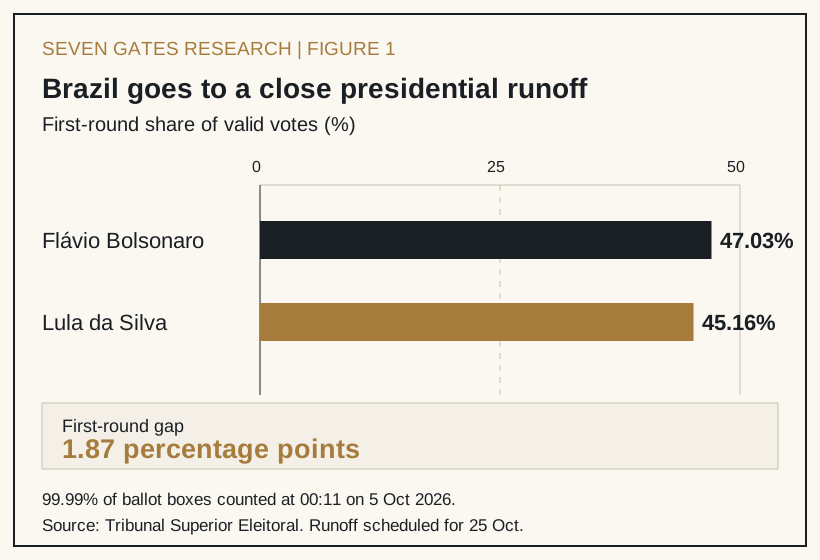
With 99.99% of ballot boxes counted, Brazil's Superior Electoral Court reported 47.03% of valid votes for Flávio Bolsonaro and 45.16% for President Luiz Inácio Lula da Silva. Neither cleared 50%, so the two meet again on 25 October. The chart shows how little separates them, while also warning against treating a first-round lead as a final result.
Brazil matters to Nigeria as a commodity exporter, emerging-market capital competitor and democratic comparison. Policy signals on fiscal discipline, Petrobras, agricultural exports and China will affect the real and parts of the global food complex. Cabinet choices and congressional arithmetic matter more than Monday's opening move.
Source: Brazil Superior Electoral Court, 5 October.
4. France's debt is now an exchange-rate problem
France's public debt reached 119.0% of GDP in the second quarter, up from 117.5% in the first, according to INSEE's 29 September release. On 5 October the euro fell 0.6% to a 17-month low of $1.1185 as investors focused on French fiscal and political risk. The movement is not proof of a sovereign crisis, but it shows that national budget credibility can affect a shared currency.
Higher European yields and wider risk premia can raise the return demanded on emerging-market Eurobonds. A weaker euro also changes the naira cost of European imports relative to dollar-priced goods. Watch the French-German spread, budget negotiations and euro funding conditions together.
Sources: INSEE, 29 September · Reuters, 5 October.
5. Washington creates an AI coordinating force
President Donald Trump named intelligence director Jay Clayton on 4 October to lead a federal task force on artificial intelligence, alongside officials from the Federal Trade Commission, personnel office and Pentagon. The administration calls it the “Super Intelligence Force”. Its stated remit includes engagement with consumers, public-interest groups, infrastructure providers and technology companies.
Composition matters more than branding. Intelligence, competition, labour and defence concerns now sit inside one structure, following a voluntary industry accord and a 29 September terminology order. Nigeria should not copy the label. It should answer the institutional question: who is accountable when AI policy crosses security, consumer protection, employment and critical infrastructure?
Sources: Associated Press, 4 October · White House executive order, 29 September.
Three numbers worth remembering
- Seven: Iranian conditions attached to reopening Hormuz.
- 1.87 percentage points: Flávio Bolsonaro's first-round lead over Lula.
- 119.0% of GDP: France's second-quarter public debt ratio.
What could change everything?
An agreed sequence for Hormuz, followed by verified passage of commercial vessels, would reduce the largest immediate energy risk. In Ethiopia, outside military involvement would make a national war harder to contain. Brazil's eliminated candidates and congressional blocs will determine the runoff. France needs a credible budget path, not merely calmer trading.
Prepared for 5 October 2026 from sources published or updated between 29 September and 5 October. Claims by governments and armed parties are attributed; transmission mechanisms and judgements are Seven Gates analysis.