SEVEN GATES DAILY BRIEF
Bonds lost September. Equities did not notice
A global bond sell-off raises the price of money, Qatar carries another Hormuz proposal, China’s factories return to expansion, AI leaders promise voluntary controls, and an airstrike kills civilians in Myanmar.
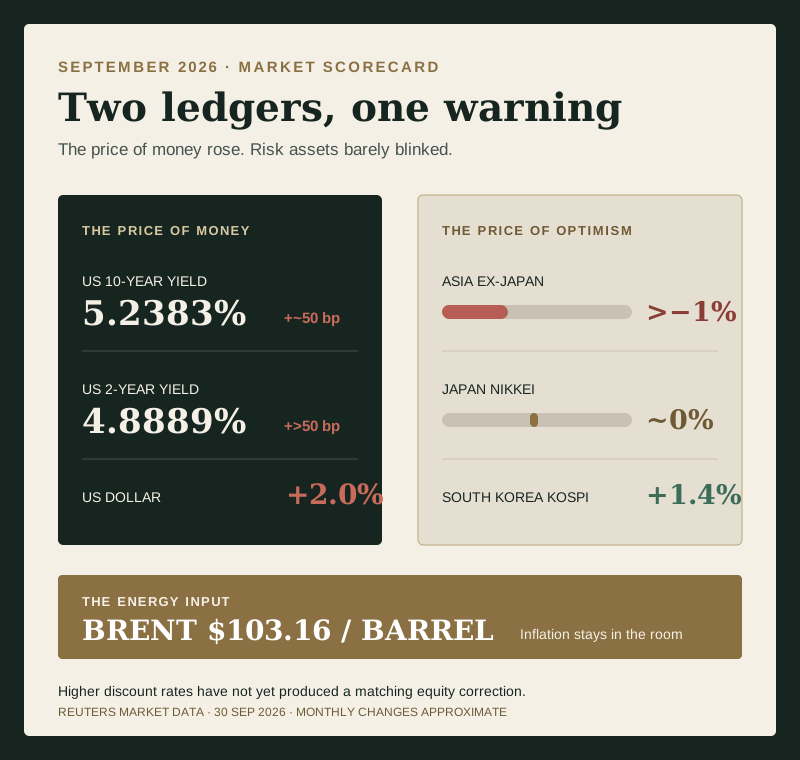
The bond market has spent September sending a bill. Equities have mostly left it unopened. That divergence can persist for a while, which is not the same thing as being free.
1. Bonds lost September. Equities did not notice
The US 10-year Treasury yield reached 5.2383%, close to its highest since 2007 and nearly 50 basis points higher this month. The two-year yield is above 4.88% after rising more than 50 basis points. German and French 10-year yields have touched 17-year and 18-year highs.
Stocks have been remarkably calm. Asia-Pacific equities excluding Japan are down just over 1% for September, Japan is roughly flat and South Korea is up 1.4%. Strong earnings and enthusiasm for AI are cushioning valuations, but a higher risk-free rate eventually reaches refinancing, mortgages and capital spending.
Nigeria feels this through three pipes. A 2% monthly dollar gain pressures the naira and imported prices. A US yield above 5.2% raises the return investors demand from Nigerian sovereign and corporate debt. Brent at $103.16 helps export receipts while keeping freight and fuel expensive. The oil dividend and the financing penalty now arrive in the same currency.
Source: Reuters, global markets, 30 September
2. Qatar has a seven-day Hormuz promise, but no bargain
Qatar says it is relaying messages between Washington and Tehran and trying to establish common ground. Iran’s proposal would start a seven-day countdown to reopen the Strait of Hormuz and pause the fighting. President Donald Trump rejected reports that he had offered sanctions relief or access to frozen funds, writing that he had offered Iran “nothing.”
The useful development is contact, not agreement. The war is in its eighth month, thousands have been killed and global energy supply remains impaired. A navigation deal would remove part of the premium now embedded in oil, inflation expectations and bond yields. Without reciprocal terms on sanctions, nuclear activity and Gulf security, seven days is a timetable attached to a disagreement.
Sources: Qatar Ministry of Foreign Affairs, mediation update, 29 September · Reuters, Iranian proposal and US response, 29 September
3. China’s factories are expanding again, narrowly
China’s official manufacturing purchasing managers’ index rose from 49.8 to 50.1 in September, ending two months of contraction. Production reached 51.7 and new orders 50.5. A private survey was stronger at 52.1, while the official services and construction measure recovered to 50.2.
The composition matters more than the threshold. AI demand and resumed production are supporting factories, but weak consumption, investment and property confidence still make the recovery uneven. Output is doing more work than households. For commodity exporters and manufacturers, this is better demand news, not yet a broad Chinese reflation.
Sources: China National Bureau of Statistics, September PMI, 30 September · Reuters, China factory activity, 30 September
4. AI companies have written themselves a safety constitution
OpenAI, Anthropic, Meta, Google and Nvidia are among the companies backing a White House accord on frontier AI controls. It calls for internal monitoring, outside auditors and board committees, including checks designed to stop models from hacking or accessing systems unintentionally.
This is a practical answer to recent agent failures, but it is voluntary and has no disclosed enforcement mechanism. Independent testing can improve accountability only if auditors have access, standards and consequences. A constitution without a court is still a promise with excellent stationery.
Source: Reuters, text and signatories of the AI accord, 29 September
5. An airstrike has killed civilians in Myanmar
A reported Myanmar military airstrike on a crowded market in Kyauktaw killed 50 people and wounded at least 58, according to the Arakan Army and a local aid worker. Women and children were among those recovered. The military did not respond to Reuters; the United Nations said the toll could rise.
The strike is the deadliest reported in Rakhine state since a hospital bombing in December. It also demolishes the fiction that displaced people can safely return while air power is used against populated areas near the Bangladesh border.
Source: Reuters, UN response and reported casualties, 29 September
Three numbers worth remembering
- 5.2383%: the US 10-year yield, the global price tag on risk.
- Seven days: Iran’s proposed countdown to reopen Hormuz.
- 50.1: China’s official manufacturing PMI, barely back in expansion.
Sources are linked in items 1, 2 and 3.
What could change everything?
A detailed US-Iran package with reciprocal steps would lower the energy and inflation premium at its source. Absent that, the more immediate hinge is whether equities finally acknowledge the bond market’s higher discount rate. In China, sustained new orders rather than one month above 50 would turn a factory bounce into a recovery.
Prepared for 30 September 2026 from sources checked through 04:35 UTC. Market levels move, diplomatic proposals may change and casualty figures remain provisional; transmission mechanisms are Seven Gates analysis.