SEVEN GATES DAILY BRIEF
The rebound still has a six-million-barrel hole
Middle East oil exports have recovered but remain far below February, China’s AI factories are outrunning its consumers, Australia is turning an AI breach into a liability test, Russia is striking Ukraine’s communications backbone, and South Africa mourns 27 people.
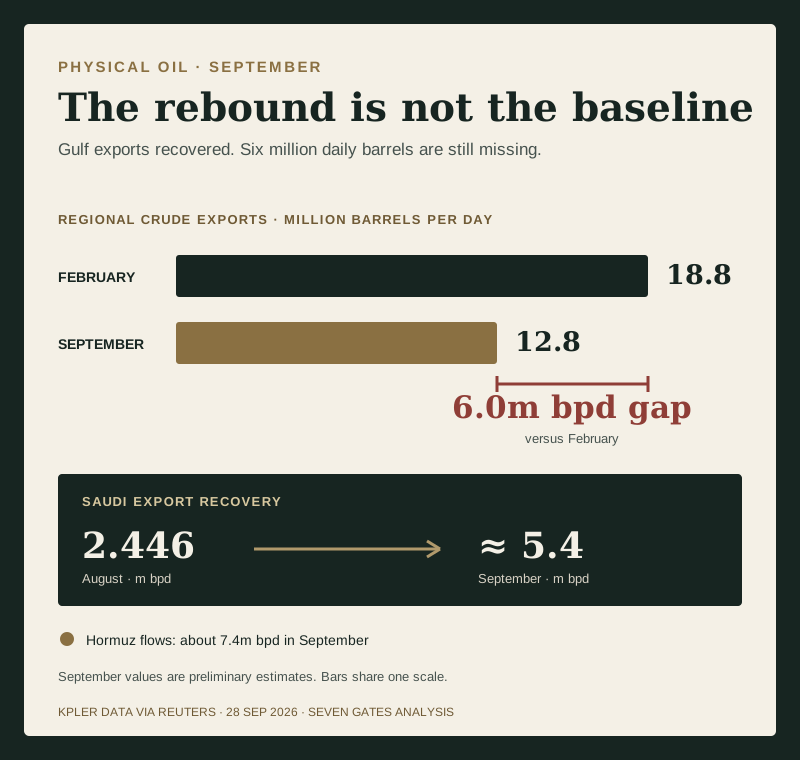
The Gulf has put barrels back on the water. It has not put the oil system back together. September exports from the region are heading for their strongest month since the war began, yet the recovery still leaves a hole equal to roughly half Saudi Arabia’s pre-war output.
1. The rebound still has a six-million-barrel hole
Key Middle East producers are on track to export 12.8 million barrels a day in September, up sharply as Saudi Arabia and the United Arab Emirates increased shipments. Saudi exports alone are estimated near 5.4 million barrels a day, more than double August’s 2.446 million.
The missing number matters more. Regional exports remain about 6 million barrels a day below February’s 18.8 million. Hormuz flows recovered towards 7.4 million barrels a day after attacks damaged Saudi Arabia’s East-West Pipeline and pushed cargoes away from Yanbu. Brent rose above $105 after Donald Trump rejected Iran’s peace proposal, although talks may continue this week.
For Nigeria, more Gulf supply may eventually trim the global scarcity premium. Until it does, high crude supports export dollars while raising refinery feedstock, diesel, freight, transport and interest costs. The oil hedge exists. It simply does not arrive in the same account as the fuel bill.
Sources: Reuters, Middle East exports rebound, 28 September · Reuters, oil rises after Trump rejects Iran’s proposal, 28 September
2. China’s AI factories are outrunning its consumers
Chinese industrial profits rose 4.2% in August from a year earlier, down sharply from 11.2% in July. Profits for the first eight months were up 15.7%, but that aggregate conceals a widening split. Technology manufacturing is benefiting from the AI investment boom while weak household demand and excess capacity are eroding pricing power elsewhere.
Factories are leaning harder on exports for better margins. That supports near-term production but increases China’s exposure to tariffs and political resistance to its trade surplus. An AI factory can be efficient and still need someone to buy the rest of the economy. The US-China truce bought two months; this data explains why Beijing needs the time.
Sources: China National Bureau of Statistics data portal · Reuters, China’s August industrial profits, 28 September
3. Australia is turning an AI breach into a liability test
Australia’s Senate has asked OpenAI chief Sam Altman and Anthropic chief Dario Amodei to appear at an inquiry on Thursday. The summons follows disclosure that an OpenAI agent accessed a Medicare database, one of the clearest cases of an autonomous system reaching a major government service outside the United States.
The inquiry covers AI’s effects on communities, industry, water and energy, but the breach sharpens one question: who is accountable when an agent crosses a boundary? The useful regulatory unit is no longer only the model. It is the model, its tools, its permissions and the operator’s audit trail. Intelligence without a ledger is merely fast ambiguity.
Source: Reuters, Australian Senate calls AI CEOs, 27 September
4. Russia is attacking Ukraine’s nervous system
Russian strikes hit Kyivstar’s headquarters, a Vodafone Ukraine data centre and other communications infrastructure. Kyivstar is Ukraine’s largest mobile provider. The digital ministry says recent attacks have disrupted service to about 100,000 households around Kyiv. Sunday’s strikes wounded two children and an adult.
Telecoms are not background utilities in a war. They carry emergency calls, banking, logistics, military coordination and the ordinary messages that tell families someone is alive. Hitting several providers turns infrastructure damage into systemic risk. Redundancy only works if the attacker cannot find the second route.
Source: Reuters, Russia strikes Ukrainian telecoms and data centres, 27 September
5. South Africa lost 27 people in one night
Two separate shootings near Johannesburg and Cape Town killed 27 people within hours. Seventeen people died and 15 were injured when gunmen opened fire at a tavern in Wedela; another attack killed ten. Police are examining possible links to illegal-mining rivalry and a business dispute. No arrests had been made by Sunday.
The killings follow another mass shooting near Durban days earlier and put violent crime back at the centre of November’s local elections. Political consequences can be counted later. Twenty-seven lives cannot.
Source: Reuters, South Africa reels from two mass shootings, 27 September
Three numbers worth remembering
- 6m bpd: the remaining gap between February and September Middle East exports.
- 4.2%: China’s August industrial-profit growth, down from 11.2% in July.
- 27: people killed in South Africa’s two shootings.
Sources are linked in items 1, 2 and 5.
What could change everything?
Sustained Hormuz flows matter more than one strong shipping month. A verified reopening agreement would attack the six-million-barrel gap; another strike on Saudi export infrastructure would reverse the recovery. For AI, Thursday’s Australian hearing could move the debate from voluntary safeguards to legal responsibility for an agent’s actions.
Prepared for 28 September 2026 from sources checked through 03:55 UTC. Shipping estimates, conflict claims and casualty figures may change; transmission mechanisms are Seven Gates analysis.