SEVEN GATES DAILY BRIEF
Hormuz has lost its diplomatic floor
Donald Trump has publicly rejected Iran’s seven-day proposal, the US-China summit bought two months rather than a settlement, Nigeria approved an $800 million gas bridge, FBI personnel data became leverage, and Mexico prepared for Hurricane Polo.
Yesterday, the seven-day exit still carried a question mark. Today it has an answer: no. Donald Trump’s public rejection of Iran’s proposal removes the clearest diplomatic floor beneath oil, shipping and rates. Markets reopen with less ambiguity and no more peace.
1. Hormuz has lost its diplomatic floor
Trump said on Saturday that he had rejected Tehran’s offer to reopen the Strait of Hormuz within seven days and end regional hostilities. Iran’s package, conveyed through Qatar, also left room for nuclear talks. Washington preferred to keep the blockade and military pressure in place.
That changes the market event. A reported disagreement has become a public decision. The war, which began on 28 February and has killed thousands, continues to restrict the world’s most important oil chokepoint. For Nigeria, higher crude can strengthen export receipts while dearer feedstock, diesel, freight and transport lift inflation and local yields. The producer’s hedge remains badly distributed.
Source: Reuters, Trump rejects Iran’s Hormuz proposal, 26 September
2. Washington and Beijing bought two months, not a settlement
Donald Trump and Xi Jinping ended three days of talks with a National Archives tour and few large public breakthroughs. They extended their trade truce for two months beyond 10 November and granted exemptions for some agricultural, medical and consumer goods. The difficult files, including advanced technology, Taiwan and China’s relationship with Iran, remain difficult.
The extension lowers the immediate risk of another tariff escalation but does not supply durable rules for trade or AI. Two more meetings are planned around November’s APEC summit and December’s G20. Diplomacy has created another appointment. It has not yet created predictability. The tour had more documents than the deal.
Source: Reuters, Trump and Xi conclude their US summit, 25 September
3. Nigeria has approved a gas bridge to Train 7
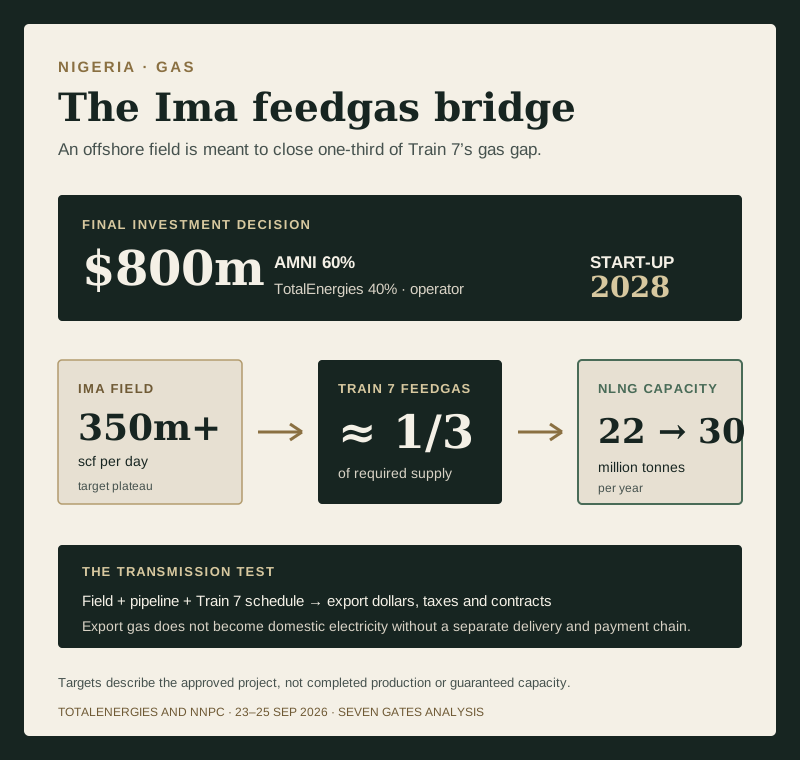
TotalEnergies and AMNI have taken final investment decision on the $800 million Ima offshore gas project. TotalEnergies, the 40% operator, targets start-up in 2028 and a plateau above 350 million standard cubic feet per day. AMNI holds 60%. The gas is expected to provide roughly one-third of the feedstock required by Nigeria LNG’s Train 7, which is designed to lift capacity from 22 million to 30 million tonnes a year.
This is useful capital, but the transmission is specific. Ima can generate export dollars, taxes and contracting work if the field, pipeline and Train 7 schedules meet. It does not automatically become power for Nigerian homes or factories. Export gas and domestic electricity share a molecule, not a payment chain.
Sources: TotalEnergies, Ima project decision and targets · NNPC, $800 million Ima final investment decision · Reuters, project structure and Train 7 role, 25 September
4. FBI personnel files have become counterintelligence material
Hackers calling themselves ShinyHunters say they stole two to three terabytes from FBI recruitment and internal systems. Reuters partially authenticated files containing Social Security numbers, medical evaluations and psychiatric records; the FBI says it is aggressively investigating. The group has exaggerated claims before, and the full scope is unverified.
The confirmed sample is already serious. Personnel security is national-security infrastructure because intimate data can expose, embarrass or coerce the people trusted to protect institutions. A password can be reset. A psychiatric history cannot.
Source: Reuters investigation, FBI staff medical records, 25 September
5. Hurricane Polo still carries two landfalls
Polo weakened from Category 5 to Category 4 on Saturday, with sustained winds near 145 miles per hour. It is forecast to strike Baja California Sur on Monday before crossing towards a second landfall in north-western mainland Mexico. Forecast rainfall of four to eight inches, locally ten, keeps flash floods and mudslides dangerous even if the wind category falls again.
A lower number on the Saffir-Simpson scale is not an all-clear. Water keeps its own category.
Sources: US National Hurricane Center, Hurricane Polo advisories · Reuters, Polo’s track and hazards, 26 September
Three numbers worth remembering
- 7 days: the Hormuz reopening timetable Trump rejected.
- 2 months: the extension of the US-China trade truce.
- 350m scf/day: Ima’s targeted gas plateau from 2028.
Sources are linked in items 1, 2 and 3.
What could change everything?
A monitored partial reopening of Hormuz would put a price back on diplomacy. Until then, a strike on export infrastructure, a disruption to Saudi bypass routes or formal US escalation would move oil before economic data does. For Nigeria, the separate proof point is contractual: a Train 7 schedule matched by actual Ima construction and bankable feedgas delivery.
Prepared for 27 September 2026 from sources checked through 03:55 UTC. Conflict claims, storm forecasts and project targets may change; transmission mechanisms are Seven Gates analysis.