SEVEN GATES RESEARCH · EQUITY RESEARCH · NIGERIA
How Do You Sleep at Night Knowing You Own Vitafoam?
Debt has nearly gone and cash generation is strong, but at N174.60 the price already assumes N12 to N14 of sustainable earnings per share, and about N7m of stock changes hands on an average day. Hold, watch, and become interested below N150.
By The Lokoja Contrarian · 3 October 2026 · Seven Gates Research
Nas worried that sleep was related to death. Nigerian motivational speakers later decided it was related to poverty. Vitafoam has spent sixty-four years taking the other side of the trade.
At a glance | Vitafoam Nigeria Plc (NGX: VITAFOAM) | Data cut-off 2 October 2026
| Reference price N174.60, close of 2 October 2026 | Market capitalisation About N262bn (post-bonus share count) |
| Nine months to June 2026 (9M FY26) PBT N20.76bn; operating cash flow N18.15bn | Balance sheet, June 2026 Borrowings N2.27bn against cash of N14.29bn |
| Seven Gates view Hold / Watch. Interested below N150. Horizon 12 to 18 months. | Base-case value N144 to N196 on N12 to N14 of sustainable EPS at 12 to 14x |
| Principal constraint Liquidity: about N7m of stock traded on an average day | Review due 2 April 2027, or on the FY2026 results if they arrive first |
The short answer
Vitafoam has recovered and the market has noticed. Debt has nearly gone, cash generation is strong and the business is a broader polyurethane platform than the mattress brand suggests. At N174.60 the price already assumes roughly N12 to N14 of sustainable earnings per share, so we hold and watch, and become interested below N150.
The constraint we would not sleep through is liquidity. About N7m of stock changes hands on an average day.
There is a peculiar Nigerian school of motivational thought which regards sleep as evidence that you do not want success badly enough.
You know the sermon.
While you are sleeping, somebody in China is working. While you are sleeping, somebody in Dubai has bought another property. Somewhere in Lekki, probably before sunrise, a man is attending a webinar called Monetise Your Purpose Before Breakfast.
Sleep six hours and poverty has apparently entered your compound.
The motivational speaker delivering this message at 11:47 p.m. will eventually finish. Then he too will go to bed. One hopes on a Vitafoam.
When I was younger, Nas supplied the considerably cooler version.
"I never sleep, 'cause sleep is the cousin of death."
Nas, N.Y. State of Mind
Nas is our OG, so he gets the microphone. The family resemblance he described is ancient. In Greek myth, Hypnos is Sleep and Thanatos is Death; they are brothers. When Sarpedon, the mortal son of Zeus, is killed in the Iliad, Zeus cannot simply cancel mortality for a son he loves. Apollo prepares the body, and Sleep and Death carry Sarpedon home to Lycia for burial. There it is, almost three thousand years before Illmatic: sleep beside death, not because sleep is evil, but because both require the body to surrender.
The motivational-industrial complex later converted the old anxiety into a business model. Rise at 4 a.m. Meditate. Run ten kilometres. Read Marcus Aurelius. Take an ice bath. Answer emails. Build generational wealth before the rest of the neighbourhood has located its slippers.
A 2026 Management Science paper using online-lending microdata found insufficient sleep associated with higher risk, particularly for morning loan applications. Somewhere in there is an untested Nigerian transmission mechanism. A properly rested borrower may be less likely to make a terrible financial decision at 6:13 a.m., default on a N27,500 loan and subsequently discover that a hypothetical PalmPay recovery agent has developed the emotional intensity of a jilted lover.
For seven or eight hours the sleeper produces almost nothing. No meetings. No PowerPoint. Nobody is "circling back", wants to "take this offline", or ambushes you with a "quick call" which, through some unexplained distortion in the space-time continuum, lasts 47 minutes. Microsoft Teams cannot find you.
Vitafoam has built a business around the whole glorious absence.
Meet Vitafoam
Vitafoam is older than the naira and, mercifully, older than the phrase sleep optimisation. It was incorporated in 1962. Ikeja began continuous polyether foaming in 1966; Aba followed in 1972, Kano in 1974 and Jos in 1982. The company listed in 1978.
A mattress begins as chemistry before anybody stitches the pretty cover. The regional factory network matters because foam takes up a great deal of truck without weighing very much. Producing closer to customers saves Nigerian road miles and shortens replenishment.
The chemistry, without the lab coat
Polyurethane: the family name. Think of it as the bread. Change the recipe and you can get a soft mattress or rigid insulation.
Polyol: one of the liquid ingredients. The soft, flexible side of the recipe.
Isocyanate: the reactive partner. Mix it with polyol and the chemistry starts building the polymer network. Useful stuff; not something to season jollof with.
Viscoelastic: memory foam. Press it and it yields slowly, then remembers where it was. A mattress with better institutional memory than some boards.
PIR: polyisocyanurate. A tougher cousin used for rigid thermal insulation, especially where heat resistance matters. Less bedtime, more cold room, roof and industrial pipe.
With apologies to whoever first described Russia as "a gas station with a country attached", Vitafoam increasingly resembles a polyurethane manufacturing platform with a famous mattress business attached.
Vitapur makes rigid insulation, panels and chemical systems. Vitavisco works in memory and high-resilience foam. Vitablom processes fibre and soft furnishings. Vono makes furniture. Vitaparts makes automotive filters. Sierra Leone takes the foam business outside Nigeria.
Who owns the rest?
| Business | Vitafoam interest | What public filings tell us about the balance |
|---|---|---|
| Vitafoam Sierra Leone | 91.28% | 8.72% non-controlling interest |
| Vitapur | 40.08% | 59.92% held by other shareholders |
| Vitablom | 40.64% | 59.36% held by other shareholders |
| Vitavisco | 40.00% | 60.00% held by other shareholders |
| Vono | 100.00% | Wholly owned |
| Vitaparts | 52.95% | 47.05% non-controlling interest |
Source: Vitafoam's accounts say the remaining shareholders in Vitapur, Vitablom and Vitavisco are dispersed; an earlier audited disclosure stated that none of the unrelated holders in Vitapur or Vitablom individually owned more than 15%. The public accounts reviewed do not identify every minority holder by name, so we do not invent an ownership register. Vitafoam consolidates the three businesses because it says its voting position is sufficiently dominant to control their financial and operating policies (management claim).
A lot of float. Not necessarily a lot of exit.
One thing Seven Gates has become increasingly wary of is the word float. It sounds liquid. It is not the same thing as liquidity.
At March 2026, Vitafoam still had three 5%-plus holders controlling 29.90% between them. The filing also showed Sanctus Nigeria Limited at 4.01% plus small director positions. The formal free-float calculation remained compliant with NGX Main Board rules. After the 2026 bonus issue, third-party market data puts the tradable float around 0.99 to 1.05 billion shares, roughly two-thirds of the company.
That looks enormous until we ask how many shares actually trade. Investing.com's current average daily volume is about 41,117 shares. At N174.60 that is only about N7.2m of stock changing hands on an average day. The September tape contains many sessions below 50,000 shares and one conspicuous 508,000-share day.
Suppose we refuse to be the market and limit ourselves to 20% of normal daily volume. A N10m position takes roughly seven trading days to unwind; N25m takes about seventeen; N50m takes roughly thirty-five. Real execution may be faster in a strong market or painfully slower when everybody wants the same door.
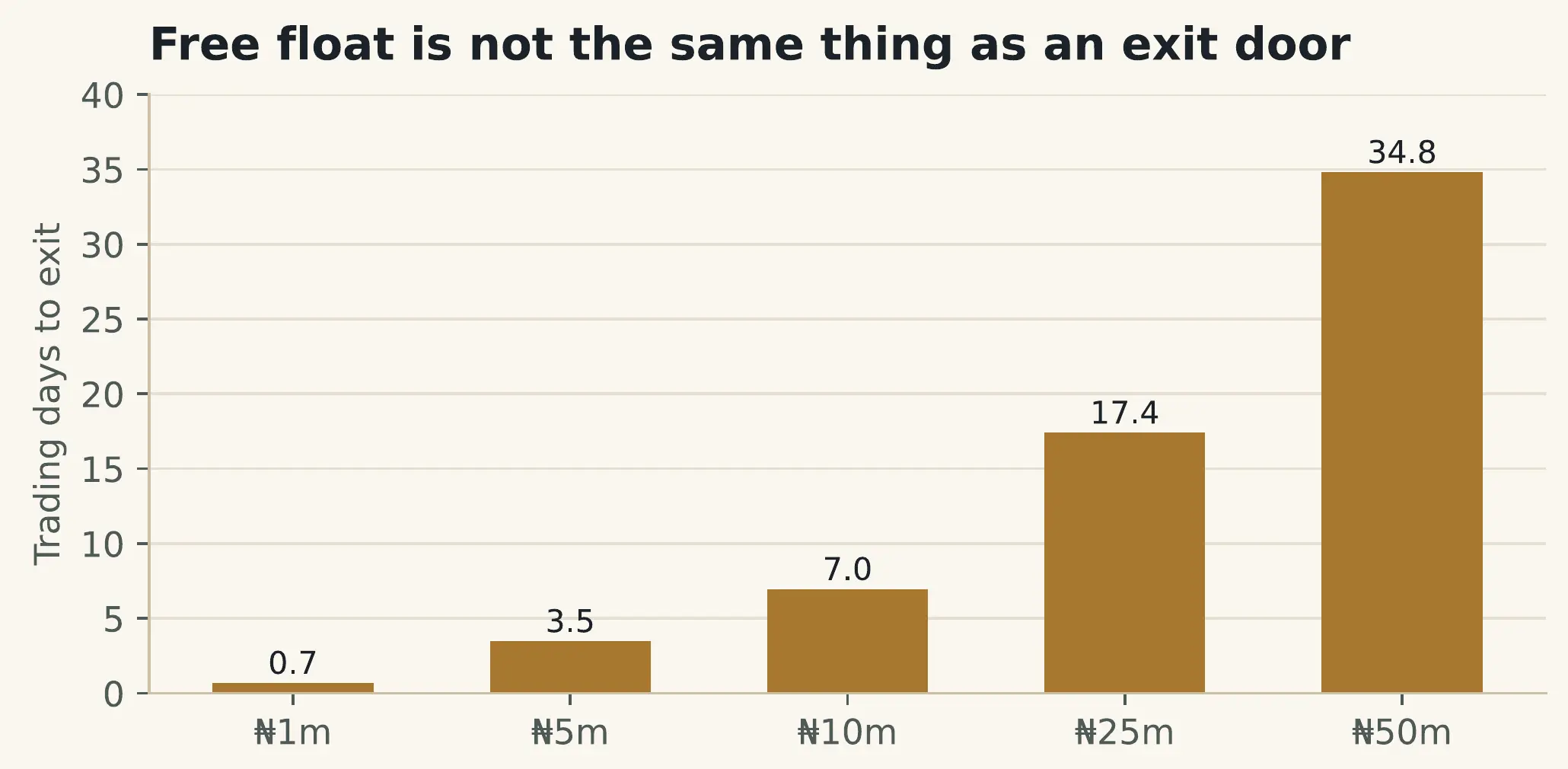
Our conclusion: Vitafoam passes the exchange's free-float test. A meaningful institutional position can still fail the Seven Gates "can we leave?" test. Position sizing must be based on traded value, not the percentage labelled free float.
Vitapur deserves a second valuation
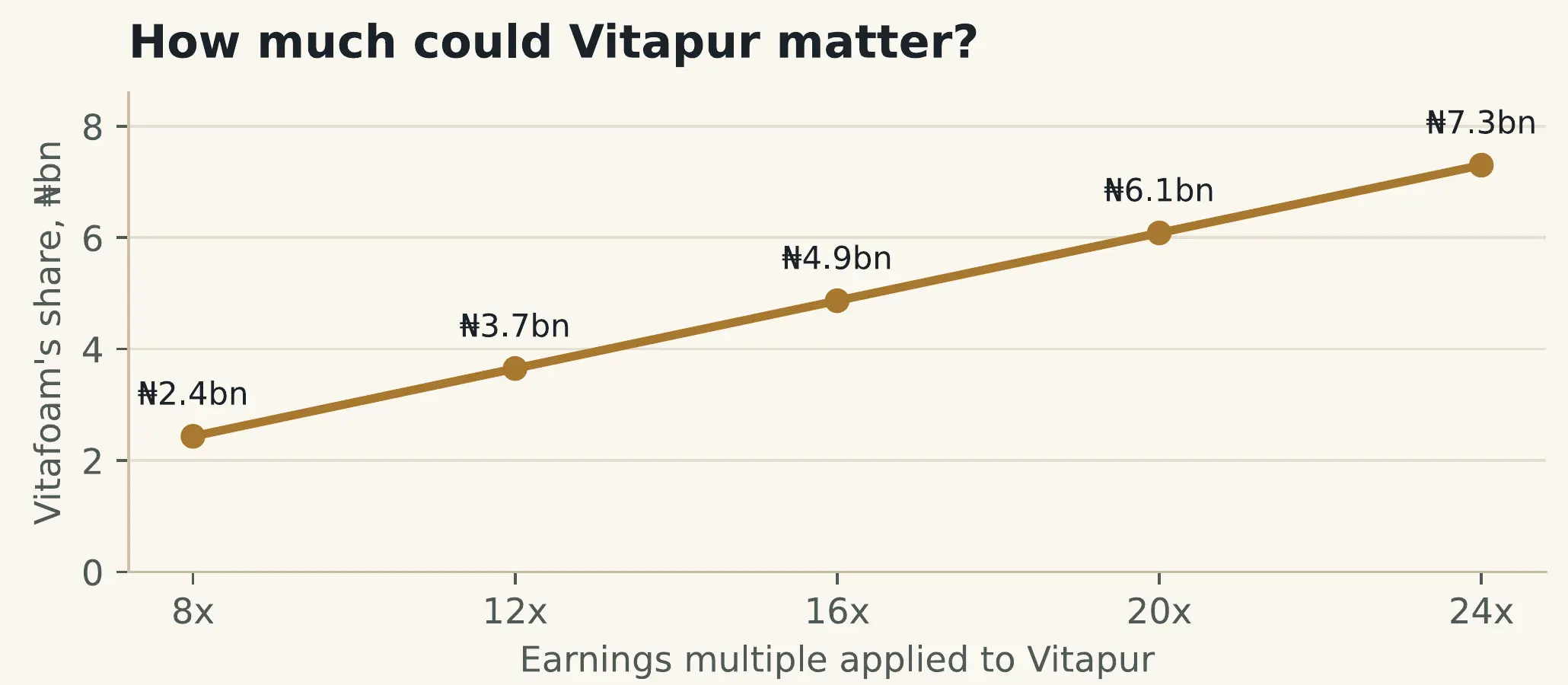
Vitapur's FY2025 reported revenue was about N7.2bn and reported retained income roughly N759m. At 12x earnings, Vitafoam's 40.08% interest would be worth about N3.7bn.
That may be too conservative if Vitapur becomes a genuine West African insulation platform. The addressable uses are wider than mattresses: cold rooms, food processing, pharmaceuticals, warehouses, industrial buildings, oil-and-gas insulation and prefabricated structures. The company itself describes rigid foam as a significant growth area.
International comparables show what a mature insulation platform can earn, although importing their multiples directly into Lagos would be reckless. Kingspan reported €9.2bn of 2025 revenue and €1.22bn EBITDA; the market valued it around 22 to 23x 2026 earnings in September 2026. Recticel, now concentrated on insulation boards and panels, trades around 10.9x 2026 EV/EBITDA. A recent Recticel acquisition of an isothermal-panel specialist was struck at up to €16.5m enterprise value against expected 2026 EBITDA of €3.5m to €4.0m, roughly 4 to 5x EBITDA.
Nigeria supplies the growth argument. Third-party industry work describes a structurally import-dependent polyurethane-panel market, with food processing, cold chain and pharmaceutical distribution as major demand pools and high-single-digit annual growth projected through the next decade. We treat those forecasts as industry estimates, not scripture.
At 16x FY2025 reported income, Vitafoam's share of Vitapur is worth roughly N4.9bn. At 20x it is about N6.1bn; at 24x, N7.3bn. Even the exuberant case is small beside Vitafoam's roughly N262bn equity value. Vitapur can become strategically important without presently being a hidden elephant inside the valuation.
The parts, with room for error
| Business | FY25 income | VF stake | Multiple | VF-attributable value |
|---|---|---|---|---|
| Sierra Leone | N1.43bn | 91.28% | 8x | N10.5bn |
| Vitapur | N0.76bn | 40.08% | 12 to 20x | N3.7bn to N6.1bn |
| Vitablom | N0.40bn | 40.64% | 8x | N1.3bn |
| Vitavisco | N0.42bn | 40.00% | 10x | N1.7bn |
| Vono | N0.09bn | 100% | 7x | N0.6bn |
| Vitaparts | (N0.12bn) | 52.95% | 0x | nil |
| Total | about N17.8bn to N20.2bn |
Illustrative Seven Gates sum-of-the-parts (reconstruction) using reported FY2025 subsidiary income as a rough earnings proxy. Intercompany transactions, minority interests and limited standalone cash-flow and net-debt disclosure constrain precision.
A short excursion into Voidancy
I should confess something about Wole Soyinka's The Interpreters. It is a particularly hard read for us.
Soyinka can construct a sentence that leaves you wondering whether you have encountered English or English has encountered you. Among the novel's young Nigerians negotiating the absurdities of post-independence society is Sagoe, a journalist, drinker and observer of nonsense. He develops his Philosophy of Voidancy: an elaborate mock-philosophy built around the thoroughly unphilosophical business of going to the toilet.
A basic bodily function acquires doctrine, vocabulary and intellectual furniture. Sleep has suffered a comparable promotion. We now have sleep coaches, sleep scores, REM analytics, circadian protocols, smart rings, smart mattresses, magnesium glycinate, mouth tape and podcasts explaining darkness.
Vitafoam has spent six decades monetising the much simpler fact that tired people eventually lie down.
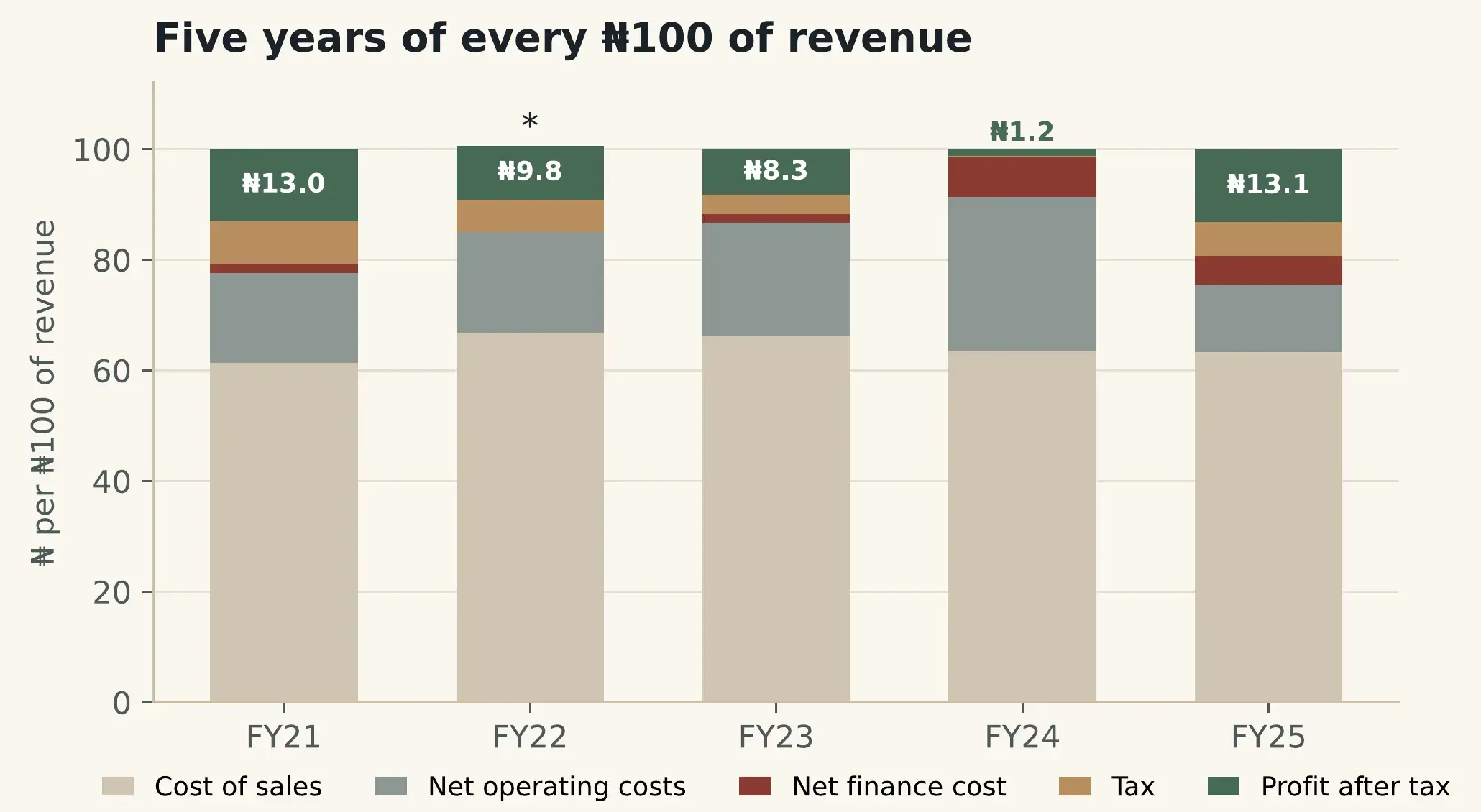
Five years in N100 notes
FY2024 was miserable. FY2025 was almost a different company: revenue reached N111.4bn, PBT N21.5bn and PAT N14.5bn. Nine months into FY2026, revenue was N91.2bn and PBT already N20.8bn.
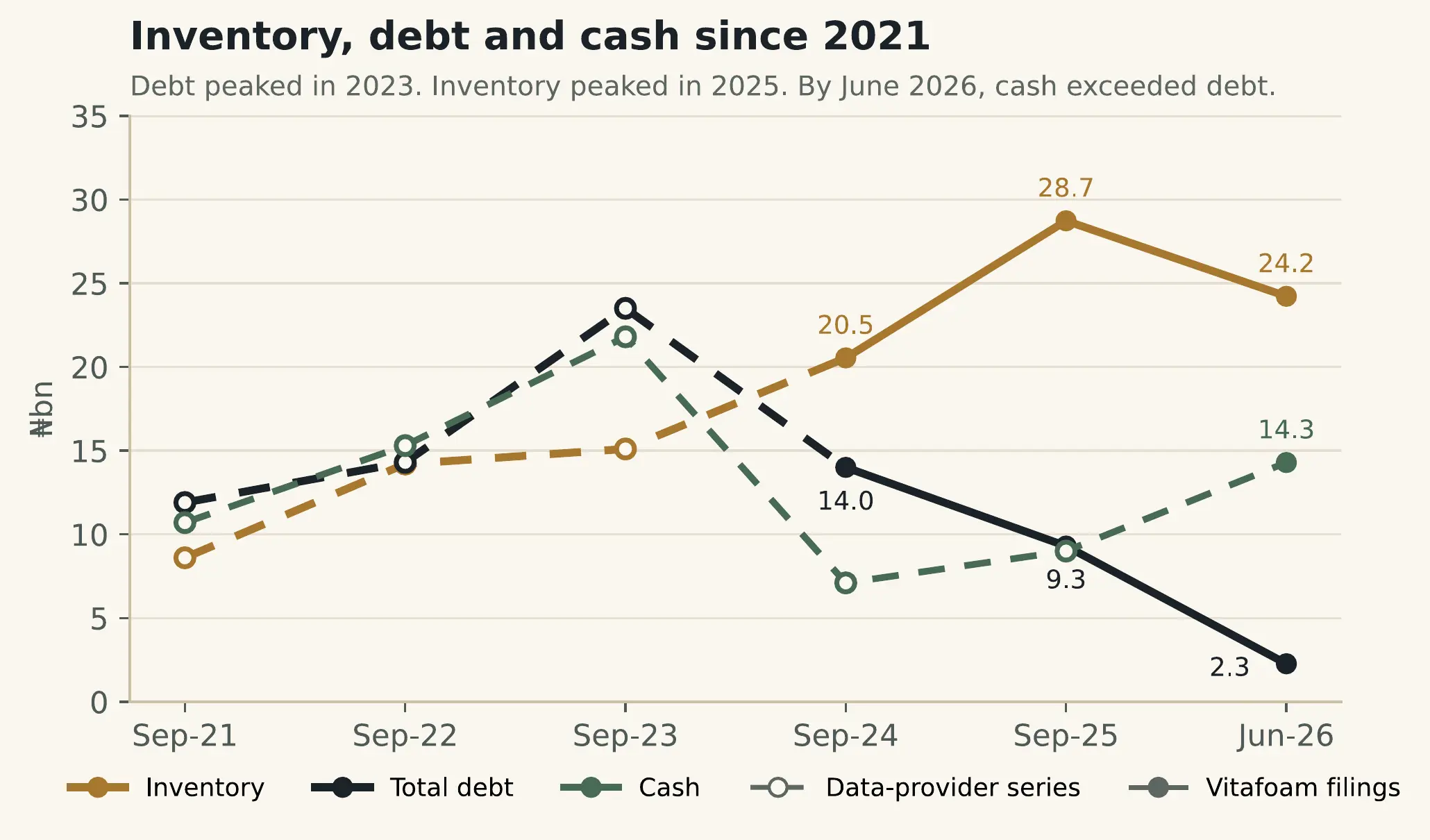
Finance cost is doing less damage. Nine-month finance cost fell to N1.34bn from N4.87bn. Borrowings had fallen to N2.27bn by June 2026 while cash stood at N14.29bn. Operating cash flow for the nine months was N18.15bn.
Inventory, debt and the price of chemicals
Inventory rose from N20.54bn in September 2024 to N28.73bn in September 2025 before easing to N24.22bn by June 2026. Raw materials alone were N21.88bn at FY2025 and N17.72bn nine months later.
The foreign-exchange note explains the economic problem without giving us the percentage we most want. Vitafoam imports some production raw materials and pays in dollars while most sales are in naira. It keeps foreign-currency accounts as a natural hedge and earns some foreign-currency receipts from Sierra Leone.
Vitapur's System House therefore has two possible jobs: sell more industrial insulation and chemical systems to outsiders, and localise parts of the chemistry used inside the wider group. How much FX exposure it can remove is still unquantified. We leave that unanswered rather than convert strategy into arithmetic.
Then the share price stopped behaving like a mattress
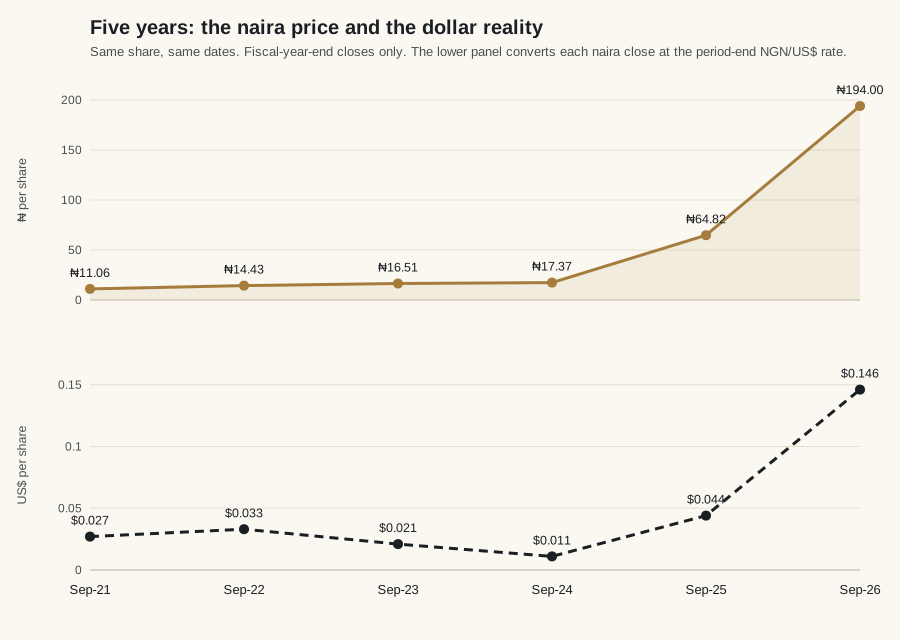
At N174.60, using the post-bonus share count, Vitafoam is worth roughly N262bn. The recovery is no longer a secret. The question for a new buyer is how much of FY2025/FY2026 can persist once lower finance cost has finished giving us easy year-on-year comparisons.
Subsidiary value helps, but not enough to carry the whole valuation. Even allowing Vitapur a substantially higher multiple leaves the six subsidiaries at roughly N18bn to N20bn on our crude attributable SOTP. The core Nigerian foam operation still has to earn most of today's market capitalisation.
For orientation, FY2025 profit after tax of N14.5bn over the enlarged share count is roughly N9.7 a share. Annualising nine-month FY2026 PBT at FY2025's tax rate gives something nearer N12.4. Both figures are before minority interests (reconstruction). N174.60 is about 18 times the first and 14 times the second.
What N174.60 requires
| Scenario | Sustainable EPS | Assumed P/E | Indicative value | What has to be true |
|---|---|---|---|---|
| Cautious | N11 to N12 | 11 to 12x | N121 to N144 | Margins normalise; growth slows |
| Base | N12 to N14 | 12 to 14x | N144 to N196 | Cash conversion and margins hold reasonably |
| Strong execution | N14 to N16 | 14 to 15x | N196 to N240 | Vitapur and core growth; low finance drag persists |
Seven Gates normalised scenarios (estimates), not company guidance or broker consensus. The per-share framework uses the enlarged post-bonus share count.
Below roughly N150, assuming the operating thesis survives, the prospective return becomes more forgiving. Above N200, we would want stronger evidence that mid-teens per-share earnings are durable.
We would revisit the thesis if debt rebuilds without productive investment, operating cash flow persistently trails profit, gross margin gives back most of the recovery, inventory rises much faster than sales, finance cost re-accelerates, or Vitapur or Sierra Leone deteriorate materially. Liquidity belongs on that list too: a large position whose thesis breaks is not useful if the market will only let us sell it by teaspoon.
One eye open
A mattress is unusually intimate capital equipment. We spend years on it, mostly with our eyes closed, unable to inspect the chemistry underneath us and generally unconscious while the product is doing its most important work.
That makes the buyer's relationship with the manufacturer rather peculiar. Vitafoam can spend decades building trust in a product whose customer is, at the moment of maximum use, in no condition to write a review.
Oscar Wilde, naturally, found the joke long before the mattress industry found memory foam. In A Woman of No Importance, Mrs Allonby asks Lord Illingworth how he can look her in the face and say such things. His reply, in paraphrase, is that he wouldn't know: he is usually unconscious at the time.
The joke lands because unconsciousness is the product's working hours. By morning, nobody cares about polyol or factories; the verdict is simpler: did I sleep, and does my back hurt? Vitafoam has been selling against that test since 1962.
Vitafoam itself has become harder to dismiss. Debt has collapsed, cash generation has improved, Sierra Leone is meaningful, Vitapur has a credible industrial runway, and the familiar mattress business is sitting on a broader polyurethane platform than the name suggests.
The share price already reflects a fair amount of this. Liquidity is thinner than the headline free float implies. Vitapur's future can add value, but even an ambitious standalone multiple does not magically justify the parent.
Nas warned us that sleep was the cousin of death. The Greeks put Sleep and Death in the same family. Wilde made unconsciousness funny. Vitafoam monetised it.
At N174.60, we can sleep. We just wouldn't sleep through the exit.
Research notes
Rating. Hold / Watch, measured against the N174.60 close of 2 October 2026 over a 12 to 18 month horizon. Interest rises below roughly N150. Review due 2 April 2027 (the six-month default), or on the FY2026 results if they are published first.
Evidence labels. Reported accounts, filings and exchange data are fact. Vitafoam's statement that it controls Vitapur, Vitablom and Vitavisco is a management claim. The exit-days table, Vitapur sensitivity, sum-of-the-parts and EPS scenarios are Seven Gates estimates; the per-share figures of N9.7 and N12.4 and the N100 revenue decomposition are reconstructions. The judgement that the price already assumes N12 to N14 of EPS is opinion.
Subsidiary income. The sum-of-the-parts uses reported FY2025 subsidiary income as a rough earnings proxy, with intercompany transactions and minority interests unadjusted. It is a range, not a valuation.
Price chart limitation. Figure 5 plots six fiscal-year-end closes, not the daily or weekly five-year history that the house standard prefers. It should be replaced with a full series once one can be verified. The September 2026 US$ value (US$0.146) was recomputed at the NFEM close of N1,329.50/US$ on 30 September 2026; an earlier draft of the chart carried US$0.136, which implied a rate near N1,426.
Third-party comparables. Kingspan, Recticel and Nigerian insulation-market figures are taken from company results, market-data providers and industry studies and are used as context only. They were supplied in the research draft and were not independently re-verified at publication.
References. The Management Science (2026) finding is cited from the research draft; the Wilde exchange is given in paraphrase because the exact wording was not re-checked at publication; the Nas line is quoted from N.Y. State of Mind (1994). Sarpedon, Sleep and Death appear in Iliad Book 16. The scenes in the opening (the 11:47 p.m. speaker, the 6:13 a.m. borrower, the N27,500 loan, the recovery agent) are hypothetical illustrations, not reported cases.
Principal sources
- Vitafoam Nigeria Plc FY2024 audited annual report; FY2025 year-end financial statements; 6M and 9M FY2026 interim filings.
- Nigerian Exchange company profile and trading data for VITAFOAM; Investing.com historical volume data and reported average daily volume.
- Vitafoam corporate website and Vitapur corporate materials for business descriptions and product scope.
- Kingspan FY2025 results; Recticel FY2025/H1 2026 results and 2026 valuation data; Recticel/Isopanel transaction for international insulation context.
- Third-party Nigeria insulation-market studies, used only as directional market estimates.
- Management Science (2026), research on insufficient sleep and financial decision-making.
- Wole Soyinka, The Interpreters; Homer, Iliad; Oscar Wilde, A Woman of No Importance; Nas, N.Y. State of Mind. Literary references are brief and used for commentary.
- S&P Global Market Intelligence/StockAnalysis price and balance-sheet series; Nairametrics, NFEM close of N1,329.50/US$, 1 October 2026.
- Seven Gates calculations: liquidity stress, SOTP, Vitapur sensitivity, N100 revenue decomposition, per-share earnings orientation and valuation scenarios.