SEVEN GATES RESEARCH · EQUITY RESEARCH · NIGERIA
Nestlé Nigeria: The Recovery Is Real and Already in the Price
Maggi, Milo and Golden Morn came through the currency shock, and profit is back. But most of this year's fall in debt came from the exchange rate, operating cash is down, the parent now wants to buy the water business, and at ₦2,750 the share already prices in most of the repair. WATCH.
By The Lokoja Contrarian · 31 October 2026 · Seven Gates Research
At a glance
| Company Nestlé Nigeria Plc, NGX: NESTLE. Nestlé S.A. holds 70.81%. | Reference price ₦2,750, close of 29 October 2026. Unchanged since 5 October. |
| Market value ₦2.180 trillion on 792,656,252 shares; about US$1.60bn at ₦1,365. | Nine months to September 2026 Revenue ₦976.5bn (+10.4%); profit after tax ₦103.4bn (+42.6%). |
| Net borrowings ₦305.9bn: borrowings ₦426.3bn less cash ₦120.4bn, 30 September. | Valuation Trailing EPS ₦171.4; trailing P/E 16.0x. No dividend for 2024 or 2025. |
| Seven Gates view WATCH. Base value ₦2,680 on 2027 earnings, about ₦2,170 in today's money. | Entry and walk-away Interest at ₦2,050 to ₦2,250. Unattractive above ₦3,200 without better cash. |
| New this week Proposed transfer of the waters and premium beverages business to Peranel, half-owned by Nestlé S.A. Price not disclosed. | Horizon and review To end-2027. Review on the Peranel circular or FY2026 results, by 28 February 2027. |
Data cut-off 31 October 2026. Reporting and price currency: naira. Dollar figures use the official NFEM close of ₦1,365 on 26 October 2026.
Milo is made from sorghum in Nigeria and barley in Ghana
Somewhere in the Caribbean, a long way from home, I went looking for a tin of Milo. I found one, and with it two surprises.
The first was the pronunciation. The shopkeeper called it MY-lo. I had grown up with MEE-lo, and it seems nobody had thought to inform me that the matter was under review. The second was the taste. It was recognisably Milo in the way a cousin is recognisably family: same bones, different accent. I drank it anyway and was grateful.
The difference turns out to be deliberate. Nestlé's own Nigerian and Ghanaian Milo pages explain that the drink is adapted to local taste and local crops. In Nigeria the malt extract comes from sorghum. In Ghana it comes from barley. One trademark, one green tin, two grains, and a pronunciation that depends on where you were standing when you first asked for it.
That is a clever way to run a global brand. It is also the first useful fact about Nestlé Nigeria as an investment, because the thing a Nigerian shareholder owns is the local version. The recipe is local, the factories are local, the customers pay in naira, and a large part of the funding has come from the parent in foreign currency. The brands crossed Nigeria's currency collapse of 2023 and 2024 with their customers intact. The balance sheet came across in considerably worse shape.
Seven Gates view
WATCH. The business is recovering in earnest. Gross margin is up more than three points, and the interest paid in cash has more than halved. The share price already reflects most of that. Our base case values the stock at about ₦2,680 on 2027 earnings, a little below the ₦2,750 reference price, and at about ₦2,170 once that value is brought back to today at a 20% annual naira return.
We would become interested between ₦2,050 and ₦2,250. Above ₦3,200, without a clear step up in cash generation, the risk and reward look poor on our assumptions.
What could prove us too cautious: volume growth that we cannot see in the disclosures, and a cash residual after interest that keeps rising. What could make the view worse: a weaker naira, a low price for the water business, or operating cash that keeps falling while profit rises. Confidence: medium.
Five years of rising sales included two years of heavy losses
The revenue line looks like a staircase. Nestlé Nigeria booked ₦351.8bn of sales in 2021 and ₦1.208 trillion in 2025, according to the five-year summary in the audited 2025 accounts. Every year was higher than the one before.
The profit line went down the stairs and through the floor. The company lost ₦79.5bn in 2023 and ₦164.6bn in 2024, almost entirely because foreign-currency loans had to be restated at a much weaker naira. Shareholders' equity went negative. Then 2025 brought a ₦105.0bn profit and a return to positive equity.
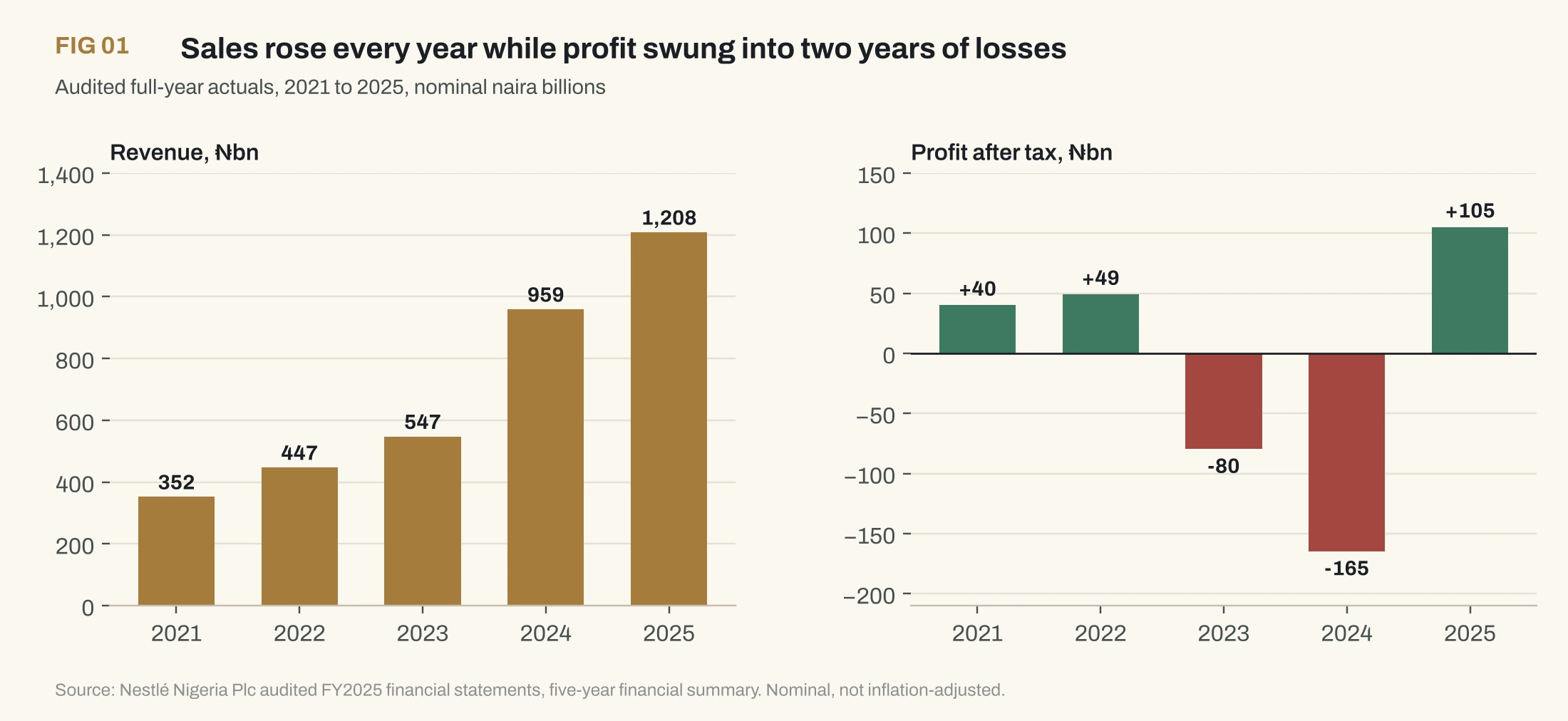
Figure 1. Revenue in nominal naira rose every year. Profit did not follow. Source: Nestlé Nigeria audited FY2025 five-year summary.
| Financial year | Revenue (₦bn) | Profit after tax (₦bn) | Reported equity (₦bn) |
|---|---|---|---|
| 2021 | 351.8 | 40.0 | 21.4 |
| 2022 | 446.8 | 49.0 | 30.3 |
| 2023 | 547.1 | -79.5 | -78.0 |
| 2024 | 958.8 | -164.6 | -92.3 |
| 2025 | 1,207.8 | 105.0 | 12.9 |
Source: Nestlé Nigeria audited FY2025 five-year financial summary. Nominal naira.
A staircase built in naira needs care. When the currency loses most of its value, imported milk powder, packaging and fuel cost more, prices go up, and reported sales can rise while households carry home fewer tins. The September 2026 accounts do not split growth into price and volume by product. Without that split, the revenue line measures money changing hands. It cannot tell us how many more breakfasts Nestlé served.
Better margins went straight back into the trucks
The nine-month results released on 29 October are genuinely encouraging. Revenue rose 10.4% to ₦976.5bn. Gross profit rose from ₦326.9bn to ₦392.9bn, lifting gross margin from 37.0% to 40.2%. Operating profit rose 14.8% to ₦208.2bn.
That 3.3-point gain in gross margin is the cleanest evidence of operating progress in the whole release. It probably reflects some mix of pricing, cheaper or more local inputs, efficiency and a calmer exchange rate. The accounts do not let us weigh the parts, so we will not pretend to.
Much of the gain was spent again before it reached operating profit. Marketing and distribution costs rose from ₦111.8bn to ₦148.4bn, about 33%, and took 15.2% of sales against 12.6% a year earlier. Getting cartons from Agbara and Flowergate to market stalls, supermarkets and kiosks across a country of more than 200 million people costs fuel, trucks, trade discounts and advertising, and all of it costs more when household budgets are squeezed and competitors want the same shelf.
The two divisions grew at very different speeds:
| Nine months to September 2026 | Food | Beverages | Group |
|---|---|---|---|
| Revenue (₦bn) | 609.4 | 367.2 | 976.5 |
| Revenue growth on 9M 2025 | 5.4% | 19.9% | 10.4% |
| Operating profit (₦bn) | 142.9 | 65.3 | 208.2 |
| Operating margin | 23.4% | 17.8% | 21.3% |
Source: nine-month 2026 segment disclosure; percentages calculated by Seven Gates. Segment revenues sum to ₦976.6bn against a reported ₦976.5bn because of rounding.
Food, which carries Maggi and Golden Morn, is the larger and more profitable division, and it grew only 5.4%. Anyone who has cooked a pot of Nigerian stew knows how hard it is to remove the seasoning cube from the recipe, which is precisely why this number deserves attention: even a staple bought almost by reflex grew more slowly than prices did. Headline inflation was 14.63% in September, according to the National Bureau of Statistics. The periods are not identical, but the direction is clear enough. On these numbers Nestlé is not yet selling more food in real terms.
The disclosure we most want is volume by major category. Price rises are not a sin. A company that grows by charging more for the same basket is in a weaker position than one that grows because more people are reaching for it.
Most of the profit increase came from the finance line
Pre-tax profit rose by ₦65.9bn, from ₦128.0bn to ₦193.9bn. Operating profit supplied ₦26.9bn of that. The other ₦39.1bn came from lower net finance costs.
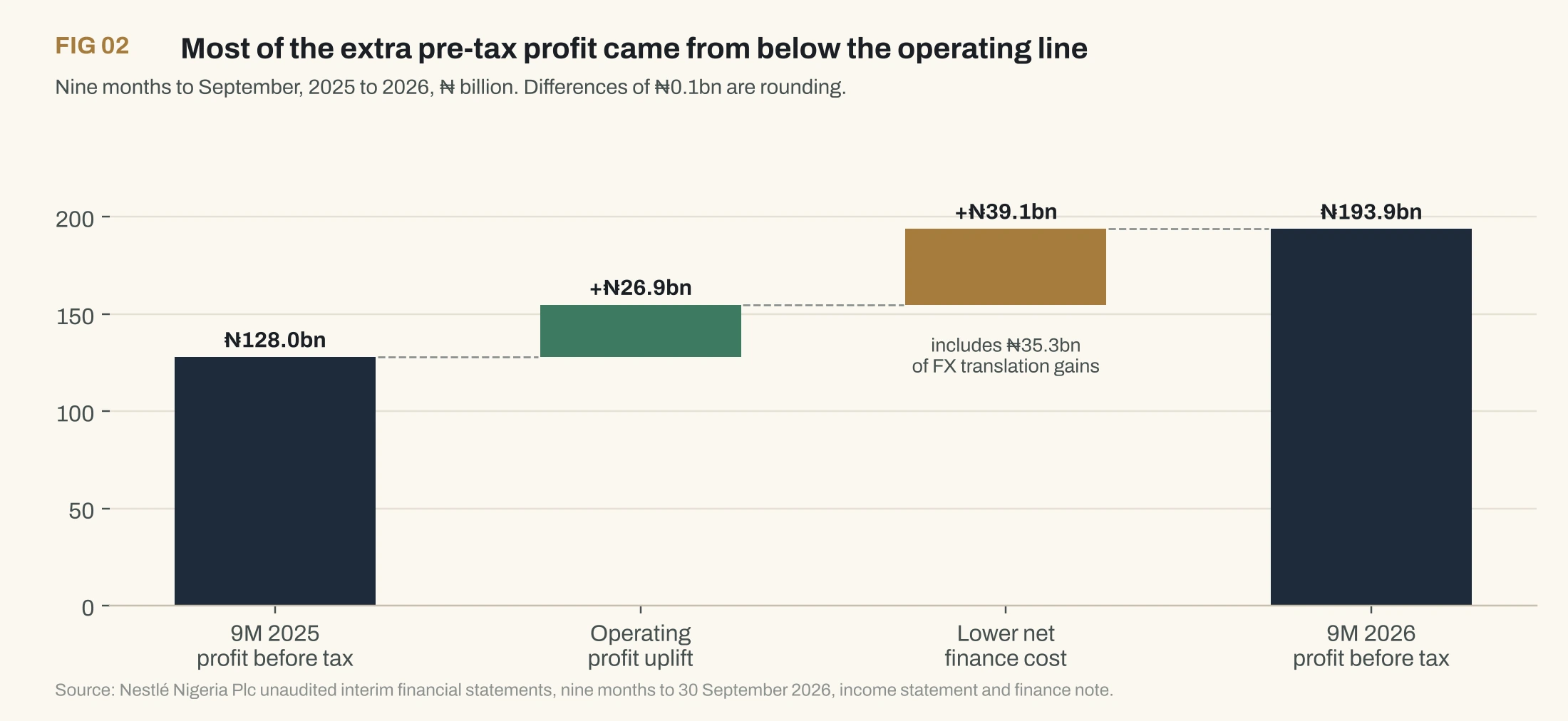
Figure 2. Bridge from 9M 2025 to 9M 2026 pre-tax profit, ₦bn. Source: 9M 2026 interim accounts, income statement and finance note.
Two different things are happening inside that finance line, and both are real. The finance income line includes ₦35.34bn of foreign-exchange translation gains: the naira strengthened, so the foreign-currency loans shrank when restated, and the accounts book the difference as income. No cash moves. Meanwhile interest expense on financial liabilities fell to ₦51.47bn from ₦75.93bn, because there is less debt and it costs less. That part is cash, and it is good news.
The translation gain is the part to hold loosely. It arrived because the naira firmed. It can leave the same way if the naira weakens, and a company with foreign-currency borrowings will feel that on the income statement within a quarter.
| Earnings bridge (₦bn) | 9M 2025 | 9M 2026 | Change |
|---|---|---|---|
| Revenue | 884.5 | 976.5 | +92.0 |
| Gross profit | 326.9 | 392.9 | +66.0 |
| Operating profit | 181.3 | 208.2 | +26.9 |
| Net finance costs | -53.4 | -14.3 | +39.1 |
| Profit before tax | 128.0 | 193.9 | +65.9 |
| Tax | -55.5 | -90.5 | -35.0 |
| Profit after tax | 72.5 | 103.4 | +30.9 |
Source: Nestlé Nigeria 9M 2026 unaudited accounts. Small differences arise from rounding reported ₦'000 figures.
Tax took ₦90.5bn, an effective rate of about 46.7% against 43.4% a year earlier. Deferred tax and timing differences move that rate around, and a single nine-month figure carries little weight. The practical point is simpler: a naira of pre-tax profit is worth a good deal less than a naira to the shareholder here, and a multiple of after-tax earnings should be applied to after-tax earnings.
Operating cash fell while profit rose
Nine-month profit after tax rose 43%. Net cash from operations fell 15%, from ₦248.4bn to ₦210.6bn. Cash spent on plant and equipment fell from ₦69.5bn to ₦62.5bn, leaving ₦148.1bn after capital spending against ₦178.9bn a year earlier.
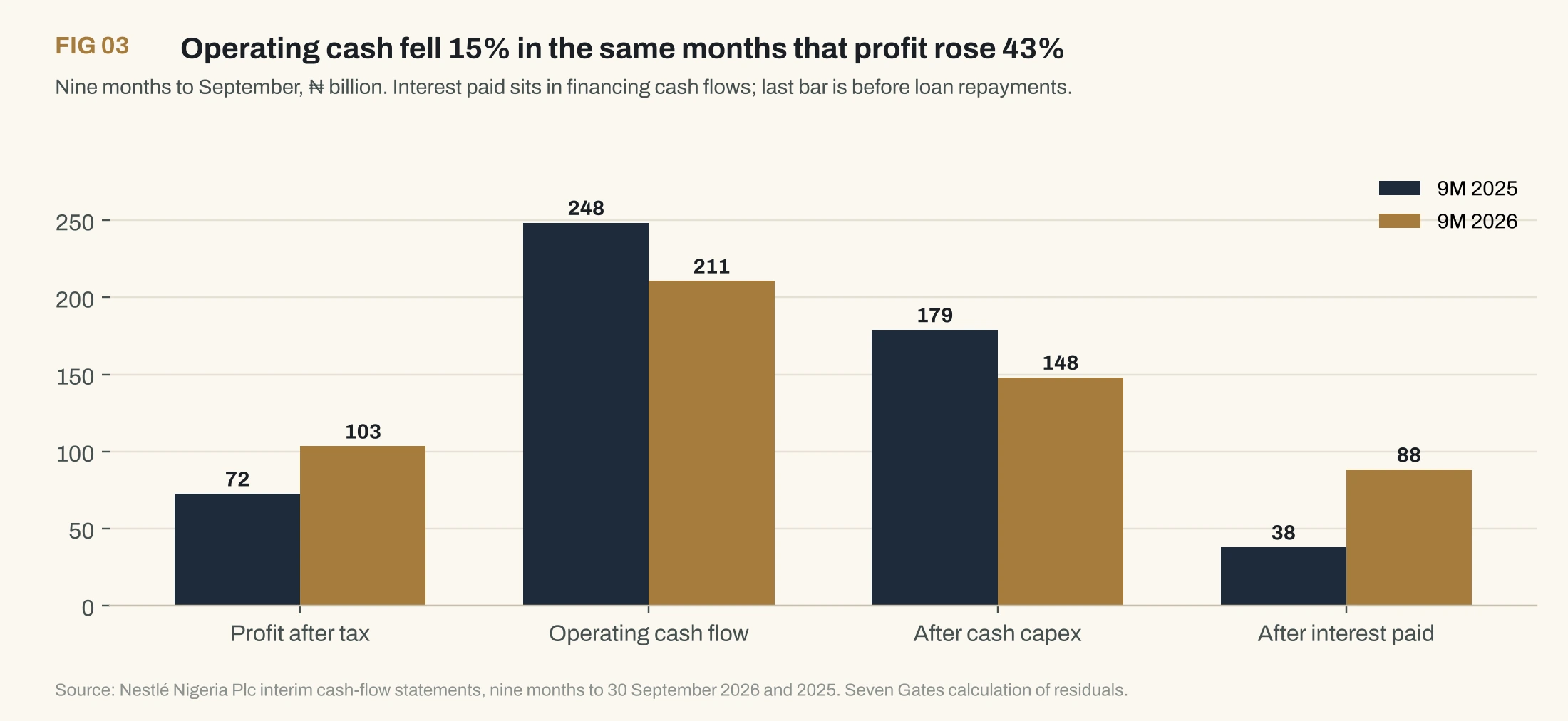
Figure 3. Nine-month cash conversion, ₦bn. "After interest paid" is operating cash flow less cash capex less interest paid, before loan repayments and dividends. Source: 9M cash-flow statements.
Nestlé reports interest paid under financing activities, so "cash after capex" here is before interest, and none of it should be mistaken for money available to shareholders. Once interest is deducted, the picture improves. Interest paid in cash fell from ₦140.9bn to ₦59.7bn, so the residual after interest rose from ₦37.9bn to ₦88.3bn.
| Cash bridge (₦bn) | 9M 2025 | 9M 2026 |
|---|---|---|
| Profit after tax | 72.5 | 103.4 |
| Net cash from operations | 248.4 | 210.6 |
| Cash capex | -69.5 | -62.5 |
| Cash after capex, before interest | 178.9 | 148.1 |
| Interest paid (financing section) | -140.9 | -59.7 |
| Residual after interest, before loan repayments | 37.9 | 88.3 |
Source: nine-month cash-flow statements; residuals calculated by Seven Gates.
The 2025 comparison flatters that improvement. In the first nine months of 2025 the company paid ₦140.9bn of interest in cash while its income statement showed ₦75.9bn of interest expense, so it paid about ₦65bn more than it expensed. By our reading, that looks like interest from the crisis years being settled late. In 2026 cash interest of ₦59.7bn sat much closer to the ₦51.5bn expensed. A good part of the jump in the residual therefore comes from a heavy base year, not only from a lighter run rate. The run rate is still lighter, which is the encouraging part.
Working capital needs watching. Inventories rose to ₦195.1bn from ₦179.9bn in December, receivables rose, and trade and other payables reached ₦318.4bn. A company of Nestlé's size pays its suppliers later than its distributors pay it, and that gap is a quiet source of funding. It holds for as long as suppliers, distributors and consumers can all afford it.
The parent is lender, controlling shareholder and now buyer
Nestlé S.A., through Société des Produits Nestlé S.A., owned 70.81% of Nestlé Nigeria at 30 September. The other 29.19% trades on the NGX. What a Nigerian shareholder holds is a claim on the Nigerian company's earnings after its creditors, its taxes and its contracts with the rest of the global group. We drew the same line in our PZ Cussons Nigeria note. The arrangement here differs, and the question it raises is the same.
The parent sits in three places. It is the controlling shareholder. It is the main lender: the audited 2025 accounts show ₦471.2bn of unsecured intercompany loans and about ₦4.8bn of secured bank loans at year-end. In the nine months to September the company paid ₦58.5bn of interest on the intercompany loans and ₦1.2bn on local bank loans. And, since this week, it is on the other side of a proposed sale.
On 29 and 30 October, Nestlé Nigeria told the NGX that its board had approved the transfer of its waters and premium beverages business to a new company that will become part of Peranel. Peranel is the 50:50 joint venture that Nestlé S.A. and the investment firm Platinum Equity announced in July for Nestlé's global water brands, among them Nestlé Pure Life. The Nigerian notice names no brands and no price. It says the transfer will be for "adequate consideration", that the board has reviewed valuations by Niyi Fatokun & Co. and KPMG and a fairness opinion from Deloitte, and that the deal needs approval from the SEC, the FCCPC and shareholders.
This could be perfectly fair. It is also the kind of transaction in which minority shareholders should read every line. The buyer is half-owned by the company's own controlling shareholder. If the proceeds were then used to repay the intercompany loan, the money would travel from a company half-owned by the Nestlé group to a company 70.81% owned by the Nestlé group and back to the Nestlé group as lender, a round trip that would leave the Nigerian minority with a smaller beverage business and a smaller loan. Nothing in the notice says the proceeds will be used that way. We raise it because the price is the whole question, and the circular is where we will look for:
- the price, and the valuation range KPMG produced;
- the revenue and operating profit of the business being sold, which probably sits in the faster-growing beverages division;
- what happens to the proceeds;
- whether Nestlé S.A.'s 70.81% votes on the resolution.
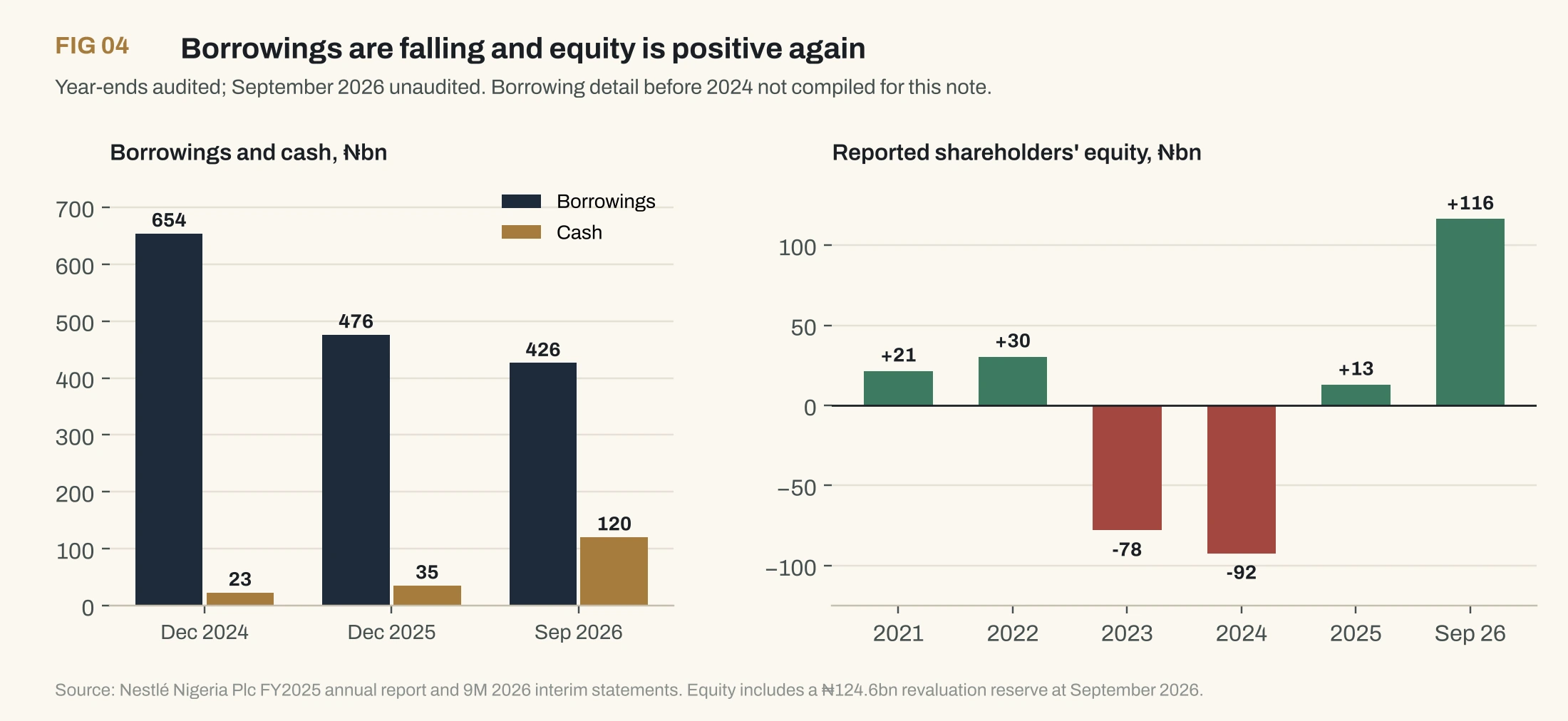
Figure 4. Borrowings means reported interest-bearing borrowings, not all liabilities. Equity includes the asset revaluation reserve. Sources: FY2025 annual report and 9M 2026 interim accounts.
The debt is falling. Interest-bearing borrowings were ₦426.3bn in September, down from ₦476.0bn in December, and cash rose from ₦35.4bn to ₦120.4bn, so borrowings net of cash fell from ₦440.6bn to ₦305.9bn. How it fell is worth a closer look. The cash residual after interest was ₦88.3bn and cash rose by ₦85.0bn, which leaves little room for loan principal to have been repaid in cash. Our inference is that most of the ₦49.7bn fall in borrowings came from translating foreign-currency loans at a stronger naira, not from repayment. The next set of accounts should confirm or correct that, and we will say which.
Book equity also needs reading carefully. September equity of ₦116.3bn includes a ₦124.6bn revaluation reserve created when the company revalued its assets in 2024. Without that reserve, equity would be slightly negative. Nobody thinks the factories are worthless; the point is that positive accounting equity does not mean a pool of distributable profit.
That pool is about to refill, though. Accumulated losses were about ₦9.4bn at September, and the company earned ₦38.6bn after tax in the third quarter alone. A fourth quarter anywhere near that would put retained earnings back above zero by December. There was no dividend for 2024 or 2025. A dividend for 2026 is therefore a live question for the board in February, and it brings the parent's three roles into one decision. Every naira paid out sends about 71 kobo to the parent as shareholder; every naira kept could repay the parent as lender.
The share price has not moved since 5 October
Nestlé Nigeria closed 2024 at ₦875 and 2025 at ₦1,958. It reached ₦3,395 on 31 March 2026 and closed at ₦2,750 on 29 October, where, according to the same report, it had stood unchanged since 5 October. The results therefore left the quoted price where it was, and where it had been for three weeks.
A price that has stood still for that long records the last trade large enough to move it. It says little about where anyone could deal today in size. Daily traded value has not been compiled for this note, so the time needed to build or exit a position is unmeasured, and measuring it comes before any upgrade.
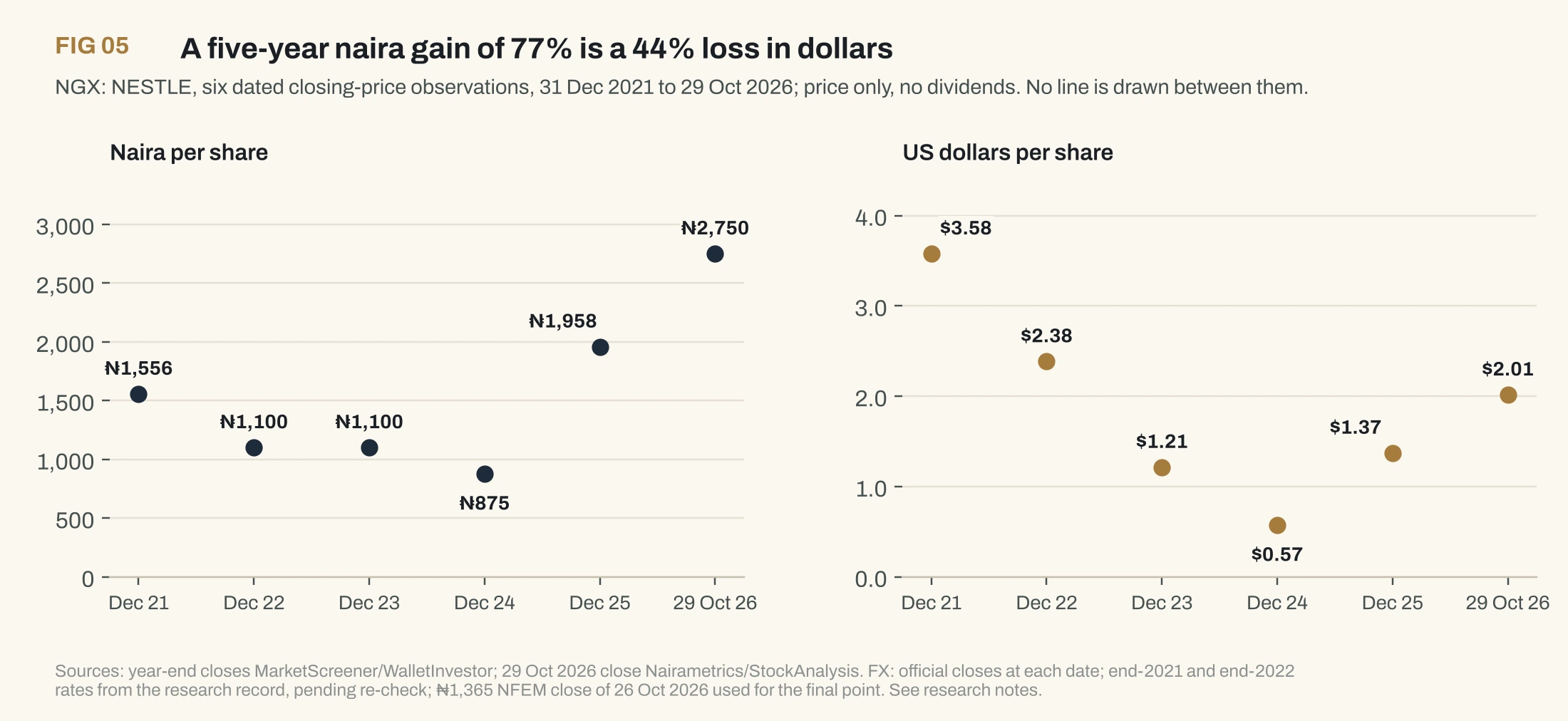
Figure 5. Five-year price record on matched dates, naira and US dollars, price only. A sparse series: six dated observations, not a daily history. Sources and FX basis in the research notes.
The five-year record depends heavily on which currency you measure it in. In naira, the share is up 77% from the end of 2021. In dollars it is down 44%, from about US$3.58 to US$2.01, because the naira went from about ₦435 to ₦1,365 over the same period. This year alone the share is up 40% in naira and 47% in dollars, helped by a firmer currency. A Nigerian saver who measures wealth in naira and a foreign investor who measures it in dollars have had two very different experiences of the same share.
The trailing twelve-month profit, which is the 2025 result plus the nine months of 2026 less the nine months of 2025, comes to ₦135.86bn, or ₦171.4 a share. At ₦2,750 that is 16.0 times earnings. For a famous consumer franchise that looks undemanding by global standards. But Nigeria does not offer a global cost of capital, stable input costs or reliable access to foreign currency, and the right comparison is the return a naira investor can earn elsewhere, which is high.
The price implies a target. At 13.5 times 2027 earnings, ₦2,750 needs about ₦204 of earnings a share, or ₦161.5bn of profit, roughly 19% above the trailing figure. At 12 times it needs ₦229; at 16 times, ₦172. The answer swings a long way with the multiple, so the price rests largely on how durable investors believe the recovery to be.
Three 2027 outcomes, one of them above today's price
The scenarios below are our own illustrations, not company guidance or broker consensus. Each is a different economic world, not a different spreadsheet setting. Values are equity value per share on 792.656 million shares, and they describe the business as currently reported, before any effect from the water sale.
| Scenario | 2027 revenue | Net margin | Net income | P/E | Value per share | Versus ₦2,750 |
|---|---|---|---|---|---|---|
| Bear: weaker naira and falling volumes | ₦1.40tn | 7.5% | ₦105.0bn | 11.0x | ₦1,457 | -47.0% |
| Base: steadier inputs, slow volume recovery | ₦1.50tn | 10.5% | ₦157.5bn | 13.5x | ₦2,683 | -2.4% |
| Bull: real volume growth and further debt repair | ₦1.70tn | 12.5% | ₦212.5bn | 16.0x | ₦4,289 | +56.0% |
Source: Seven Gates assumptions and calculations. Excludes dividends, dealing costs and tax. Values rounded.
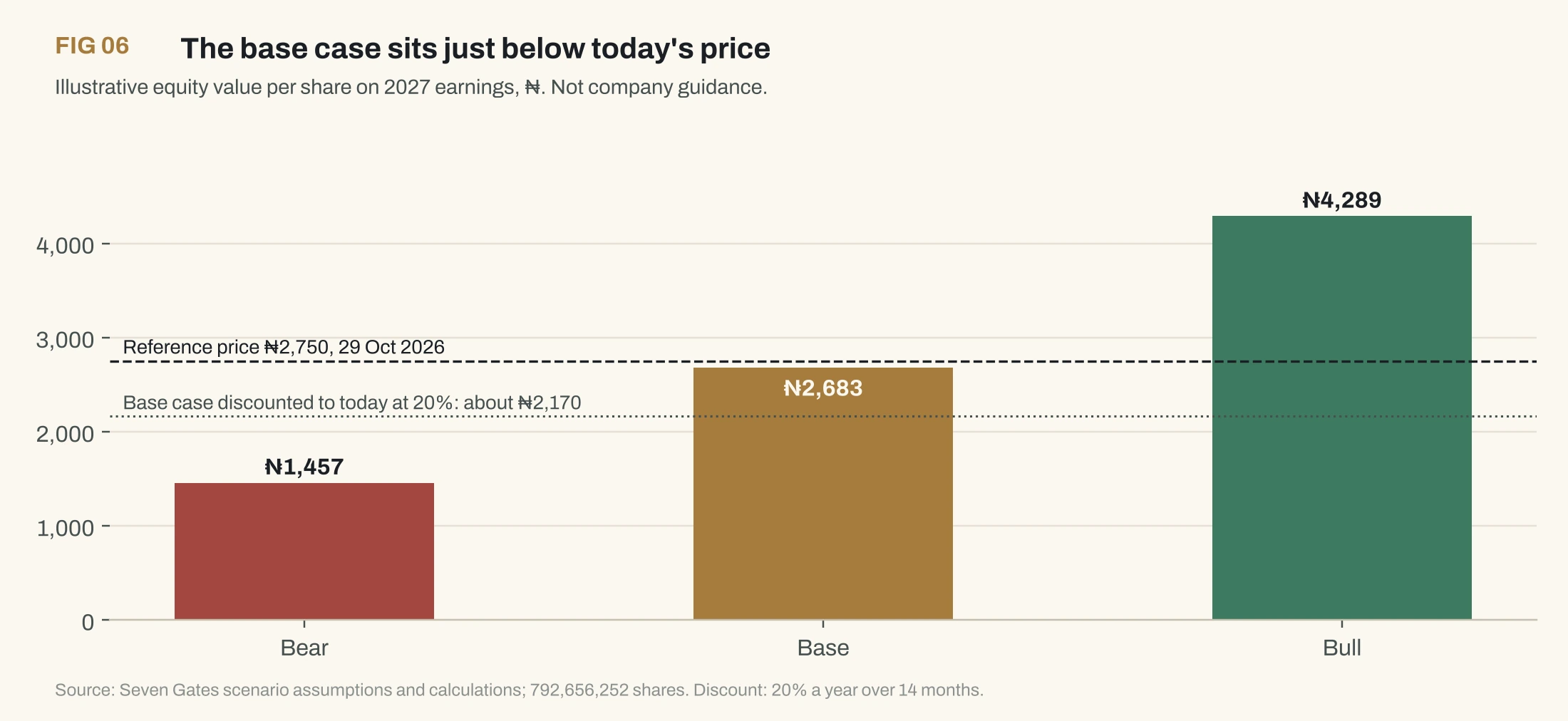
Figure 6. Illustrative 2027 values per share, ₦. The dotted line discounts the base case to today at 20% a year over 14 months. Source: Seven Gates calculations.
In the bear case the weaknesses compound. A weaker naira raises input costs and the naira value of the foreign-currency debt at the same time as stretched households resist further price rises. Margins narrow, and more of the cash goes to interest and stock. In that world the factories could run well and shareholders would still lose money.
The base case assumes the recovery continues at today's margins and pays a sensible multiple for it. It lands at about ₦2,680, almost exactly the current price. That is a value on 2027 earnings, so it belongs to the end of 2027. Brought back to today at a 20% annual naira return, which is our estimate of what a local investor can reasonably demand from an equity when inflation is near 15%, it is worth about ₦2,170. Holding the share at ₦2,750 on the base case means accepting a small loss over fourteen months while inflation runs in the teens.
The bull case is not fanciful, but it has to be earned: more units sold rather than the same units at higher prices, fuller factories, margins that hold after normal marketing spend, and further cuts in borrowing paid for with cash.
Our interest zone of ₦2,050 to ₦2,250 is where the base case starts to pay a naira investor properly, a 16% to 24% discount to the end-2027 value. Above ₦3,200, without a clear improvement in cash or sustainable earnings, the balance looks poor. Both are prompts to review the thesis.
The case against WATCH
The strongest argument against us is that we are underestimating the franchise. If the naira holds, input costs keep easing and Nestlé keeps pricing power without losing volume, earnings could compound faster than our base case, and the fall in interest payments would release cash for reinvestment and dividends. A fair price for the water business, with the proceeds used to cut the loan, would speed that up. This is a credible path, and the next two disclosures could put us on it.
The evidence that would move us, in either direction:
- Volumes. Any disclosure of volume growth in food and beverages, especially food.
- Margin after marketing. Whether the 40% gross margin holds once advertising and distribution spending settles.
- Cash against profit. Whether operating cash flow starts to rise with profit rather than against it.
- Real repayment. Cash repayment of intercompany debt, as distinct from the smaller loan balance a stronger naira produces.
- The water price. The consideration, the KPMG range and the use of proceeds in the Peranel circular.
- The dividend. Whether the board pays one for 2026, and from what.
A clear rise in volumes and a lasting increase in cash after interest would justify a higher earnings base and could take the rating to ACCUMULATE. A weaker naira, worse stock and distributor economics, rising financing outflows or a low price for the water business would justify a lower multiple, however fast nominal sales grew.
Verdict
WATCH at ₦2,750 (close of 29 October 2026). Base value ₦2,680 on 2027 earnings, about ₦2,170 today. Interest zone ₦2,050 to ₦2,250; unattractive above ₦3,200 without better cash. Horizon to the end of 2027. Review on publication of the Peranel shareholder circular or the FY2026 results, and no later than 28 February 2027.
Management has restored profit and liquidity in hard conditions, and the brands have kept their place in Nigerian kitchens. But a company with ₦426bn of borrowings, most of it owed to its parent, a recent history of negative equity, food sales falling in real terms and an undisclosed related-party sale on the table cannot be valued as though the repair were finished.
Milo changed its grain and its pronunciation without losing a customer. The loan from the parent kept its currency, and at ₦2,750 the buyer is paying now for a repair that the accounts have not yet finished.
Research notes and methodology
Accounts basis. Annual figures for 2021 to 2025 come from the audited FY2025 five-year summary. Nine-month 2026 figures and the 2025 comparatives come from the unaudited interim accounts released on 29 October 2026. The interim filing shows a minor ₦1.442m mismatch between the pre-tax profit opening the cash-flow statement and the headline income statement; we use the income statement's ₦193.881bn pre-tax profit and ₦103.374bn profit after tax throughout. The difference is immaterial.
Debt basis. Interest-bearing borrowings less cash and short-term deposits, excluding trade payables and leases. This is not the audited report's wider "net debt" measure.
Cash basis. Operating cash flow less cash capital spending is before interest, because interest paid appears in financing activities. The residual after interest is before loan principal, leases and dividends.
Inferences. Two conclusions in the text are our inferences, not company statements: that most of the 2026 fall in borrowings reflects currency translation rather than cash repayment, and that the 2025 interest payments included late settlement of earlier interest. Both rest on the cash-flow arithmetic shown and will be checked against the full-year accounts.
Price and FX basis. Year-end closes for 2021 to 2025 come from MarketScreener and WalletInvestor; the 29 October 2026 close, the 31 March 2026 high and the observation that the price was unchanged from 5 October come from Nairametrics, and the close agrees with StockAnalysis. The five-year chart plots six dated observations, not a daily series, because a verified daily history was not obtained for this note. Dollar values divide each close by the official rate on the same date: ₦435.00 (31 December 2021), ₦461.50 (30 December 2022), ₦907.11 (29 December 2023), ₦1,535 (31 December 2024), ₦1,429 (31 December 2025) and ₦1,365 (26 October 2026, the latest official close found; used for the 29 October observation). Price only; dividends are excluded, so none of these figures is total shareholder return.
Valuation. Each scenario is revenue times net margin times a chosen P/E, divided by 792,656,252 shares. The present value of the base case discounts ₦2,683 at 20% a year for 14 months (₦2,683 ÷ 1.2^(14/12) = ₦2,169). The 20% is a Seven Gates estimate of a reasonable naira return requirement, not a market rate. The scenarios do not yet reflect the proposed water sale, whose price and size are undisclosed.
Evidence labels. Figures from the audited accounts, the interim accounts, the NGX notice and the NBS are facts as reported. The Peranel terms are management statements until the circular is published. Margins, growth rates, residuals, per-share values and dollar conversions are Seven Gates calculations from those figures. The scenarios, the 20% return requirement and the fair values are estimates. The rating is opinion.
Milo. Nestlé's Ghana and Nigeria Milo pages identify barley-based and sorghum-based malt extract respectively. They do not establish the recipe of the tin bought in the Caribbean. The pronunciation and the taste are the author's recollection.
References to check. The end-2021 (₦435.00) and end-2022 (₦461.50) exchange rates are taken from the research record and have not been re-verified at this cut-off; they affect only the dollar panel of Figure 5. The 2022 and 2023 year-end closes, both ₦1,100, come from aggregators and should be checked against NGX daily lists. The NGX document link for the nine-month interim accounts is to be added; the figures were checked against the press coverage linked above.
Revision record. A draft of this note dated 30 October 2026 ("Nestlé Nigeria: The Maggi Is Back. The Debt Hasn't Left.") was rewritten on 31 October 2026. Facts added: the proposed waters and premium beverages transfer to Peranel, disclosed on 29 and 30 October; the share price high of 31 March and the unchanged price since 5 October; dollar share prices. Corrections: Ghana and Nigeria were described as neighbouring countries; they are not. The inflation figure is now attributed to the National Bureau of Statistics. Analysis added: the late-interest effect in the 2025 cash comparison, the likely translation share of the debt reduction, the timing of retained earnings, and the present value of the base case. The rating, scenario values, fair value, entry zone and walk-away price are unchanged.
Sources
- Nestlé Nigeria Plc, unaudited interim financial statements for the nine months ended 30 September 2026, NGX, 29 October 2026; reported by Nairametrics, 29 October 2026.
- Nestlé Nigeria Plc, audited financial statements for the year ended 31 December 2025, and press release, 23 February 2026.
- Nestlé Nigeria Plc, notice to the NGX on the proposed transfer of the waters and premium beverages business, 29 October 2026; reported by Nairametrics, 30 October 2026 and BusinessDay.
- Nestlé S.A. and Platinum Equity, Peranel joint venture, July 2026; reported by Food Dive.
- National Bureau of Statistics, CPI and inflation report, September 2026; reported by Nairametrics, 15 October 2026.
- Share prices: StockAnalysis (S&P Global Market Intelligence data), MarketScreener and WalletInvestor, NGX: NESTLE.
- Exchange rates: Central Bank of Nigeria official closes as reported by Blueprint (end-2024 and end-2025), Ripples Nigeria (end-2023) and WithinNigeria (26 October 2026).
- Nestlé, MILO Nigeria and MILO Ghana frequently asked questions.
- Nestlé Central and West Africa, About Nestlé in Nigeria.
Disclaimer
This publication is provided for informational and educational purposes only. It does not constitute financial, investment, tax, legal, or other professional advice, nor does it constitute a recommendation, offer, solicitation, or invitation to buy, sell, or hold any security, financial instrument, or investment. The analysis may contain opinions, estimates, assumptions, forecasts and forward-looking statements based on information considered reliable at the time of publication. Such views may change without notice, and actual outcomes may differ materially. Investing involves risk, including the possible loss of principal. Readers should conduct their own independent research, verify the information presented, consider their individual circumstances and risk tolerance, and obtain advice from appropriately qualified professional advisers before making any investment decision. Seven Gates Research accepts no responsibility for investment decisions made solely on the basis of this publication.