SEVEN GATES RESEARCH · EQUITY RESEARCH · NIGERIA
Chellarams: The Family Never Left. Neither Can You.
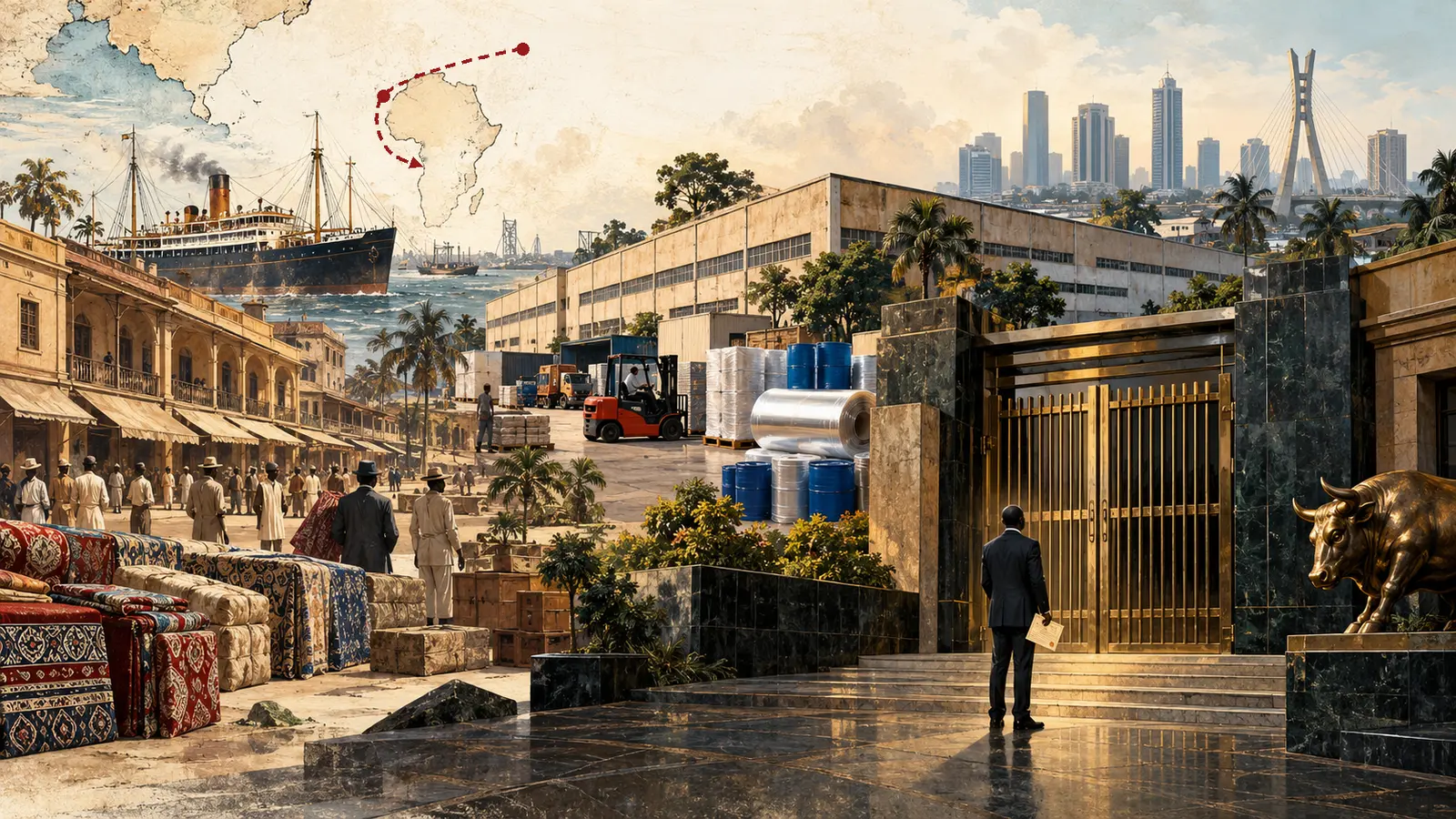
A Sindhi trading house carried its name from Hyderabad to Lagos in 1923 and stayed through empire, Partition and every devaluation since. Its Isolo yard is worth more than the whole company. In August sellers drove the price down as far as the exchange allows, three times in nine sessions, and then it stopped moving altogether.
By The Lokoja Contrarian · 23 October 2026 · Seven Gates Research
Disclosure: the author owns shares in GTCO and MTN Nigeria and holds no position in Chellarams Plc. Data cut-off 23 October 2026.
At a glance
It began, as these things do now, on a phone, a long way from Lagos.
In another life, and in a good part of this one, I have worked at the coal face of the oil business: the end where the crude comes out of the ground and the paperwork arrives later. It is a career measured in airports, rotations and other people's countries. People who live like this keep two clocks in their heads and at least two currencies. We earn in one, owe in another, and keep trying to build something in a third place that we visit more often than we live in.
One evening I was checking the two Nigerian shares I own, GTCO and MTN Nigeria, in the broker app when a name I had not thought about in thirty years surfaced in the list beneath them: CHELLARAM, in capitals, ₦9.70 beside it, and no movement. I would learn later that it had shown no movement for nine weeks. Chellarams. The department store. A name from the Broad Street of another Lagos. Forty minutes later I was reading a 1944 colonial file about a plot of land in Ikoyi, which is how these evenings go.
I expected a straightforward underwrite: an old trading house, some property, a share nobody trades. Nigerian boards are full of them. They are tightly held by a family or a parent, with a free float that exists on paper and a price that is really the memory of the last time two people disagreed. Buying one feels less like investing than like being measured for something. Peter Gabriel found the garment in 1974.
Genesis · "Back in N.Y.C." · The Lamb Lies Down on Broadway (1974)
In a trap, feel a strap
Holding still. Pinned for kill.
Chances narrow that I'll make it,
In the cushioned straight-jacket.
The song goes on to the city holding him by the neck and the feet, as it did on 22nd Street, and the pressure building past what he can take.
Gabriel meant Manhattan. The cushioned straitjacket fits a minority shareholder in Lagos rather better.
That piece is still in here, and the second half of this essay writes it. But the rabbit hole went somewhere else first. What came up was a story about migration and the movement of capital across borders; about a family refused a house by one empire and a homeland by the end of another, which kept trading through both; about greed and resilience and the plain luck of being on the quay when the ship comes in. I recognised more of it than I expected. The Chellarams were running my rotation by steamship, decades before anybody called it a rotation.
The verdict in advance
Our view is WATCH at ₦9.70, the close of 22 October 2026. Chellarams is a plausible asset-backed turnaround inside a listed structure that is unusually hard to leave. Its Isolo property is worth more than every share in issue. So, potentially, are the claims against the group, and one document nobody has published decides which of those two facts wins: a schedule showing whether the parent stands behind the debts of its dairy subsidiary, which has negative net assets of ₦5.69 billion.
Base fair value is ₦7.40 to ₦8.30 a share, a range that runs from attributable book value to a conditional break-up value with a 15 per cent haircut on the property. We would get interested below ₦6.00, and even then only by buying a little at a time over months. Above ₦11.50 the shares price in a clean separation of the loss-making subsidiaries that nobody has yet shown to be legally possible. Confidence is low to medium. Horizon 24 months. Review by 31 January 2027, or sooner if a material filing arrives.
The quoted price needs a warning label of its own. Under the exchange's rules, a share priced below ₦500 must trade at least 100,000 units in a session before its price is allowed to change; smaller trades are ignored when the price is set. On 22 October 2026 Chellarams traded 2,015 shares. ₦9.70 is less a market price than a fossil.
The five things that would change our mind are near the end. Everything in between explains how a century of staying put produced a share that behaves like this, and the explanation starts, oddly, with a family giving up its surname.
A surname for export
Somewhere in Hyderabad, in the Sindh of the nineteenth century, a family called Daryanani stopped using its name.
Nobody disowned anybody. The family had a patriarch called Chellaram whose trading reputation was worth more than the lineage, and in the merchant quarters of Sindh a surname was a working asset rather than an heirloom. Community historians say this happened often among the Bhaiband traders of Hyderabad. The firm traded on the founder's name, the founder's name became the firm, and within a generation the children answered to the brand. The Daryananis became the Chellarams. The usual gloss on the new name is "beloved of Ram". The commercial gloss is plainer: a bank in Yokohama or a customs officer in Lagos could not mistake it for anybody else.
Keep that in mind, because the name has done a great deal of travelling since, and nearly everything in this essay follows from the decision to make it portable. The name was engineered to cross oceans. A century later, the share struggles to cross a trading session.
The road out of Hyderabad
Kishinchand Chellaram was born in 1880 into a textile family and, by the family's own telling, was working in the business by fifteen. His people had a particular way of doing things. The headquarters stayed in Hyderabad and the men went out, often for years, to whichever port the British had opened. The French historian Claude Markovits, who wrote the first proper study of these traders, the Sindworkis, found not a diaspora of refugees but a network of outposts: Gibraltar, Cairo, Yokohama, Manila, Freetown, Lagos. A young man was posted to a branch the way a junior banker is now posted to Dubai.
Kishinchand followed the cloth, and the cloth kept moving: to Madras, where he set up on his own in 1915 or 1916 depending on which family account you read; to Yokohama in 1918, because Japanese cloth had become cheaper than Lancashire's and a Sindhi trader with a good name could stand in the gap between the two and charge rent on it; and in 1923 to Lagos, down the long sea road of the west African coast, to a market full of customers who had never heard of Hyderabad and had no need to. Jack Kerouac, writing about a very different road, gave his narrator the line "Nothing behind me, everything ahead of me, as is ever so on the road." The Sindworkis turned that into a business model, with one amendment. Something was always behind them: the head office, the family and the accounts that went home with every ship.
What the branch taught
Malcolm Gladwell argues in Outliers that the immigrant garment trades of New York gave families something richer than money: work with autonomy, complexity and a visible link between effort and reward, which parents then pass to their children. The Sindworki branch had all three. The manager in Lagos decided what to buy, carried the exchange risk himself, financed the cloth from Madras or Yokohama and sold it before the next ship. A mistake in freight, credit or currency ate the margin before a single bale reached Ebute Metta.
I know a milder version of that schooling. Oilfield rotations teach it in a different accent. You are sent a long way from the people who pay you, you are trusted with expensive equipment, and the gap between a good decision and a bad one shows up in a number by the end of the week. You also learn what the Sindworkis learned about money: it arrives in one currency and is spent in another, and the rate between the two can undo a good week's work. The branch taught a blunter lesson still. The trade belongs to whoever is present when the ship comes in.
The Nigerian operation dates its beginning to 1923. A family history describes a team sent out; a later magazine account has Kishinchand arriving by ship himself; a corporate-archive photograph places him in Lagos in 1936. The evidence supports the enterprise and his later presence. It does not supply a passenger list for 1923.
A police inquiry for a house in Ikoyi
What the archive does supply is a scene from 1944, and it says a good deal about staying.
In February of that year a man named Jivatsing, who managed the Lagos business of K. Chellaram and Son, applied for a residential plot in Ikoyi. (The name in the file was probably an anglicised compound spelling of something like Jivat Singh or Jeevan Singh, run together by a clerk who did not much care which. But I digress, as I am wont to do.) The colonial administration had by then stopped calling Ikoyi a European reservation, but still ran it on racial lines by other means. Officials decided that Jivatsing himself might meet the area's informal standards. The Indian employees he proposed to house with him troubled them more. He applied again in June. They ordered a Criminal Investigation Department inquiry. No crime was alleged. Both applications failed. The historian Tim Livsey found the file and published it in the Journal of African History in 2022.
A firm could supply the colony's cloth, pay its duties and employ its clerks, and still need a police inquiry to buy a house. Chellarams stayed anyway. The empire left in 1960.
Partition, and the family that went two ways
The Nigerian company was incorporated as a private limited company on 13 August 1947. Partition came the same week. For the land-owning and shopkeeping Hindus of Sindh, 1947 was ruin. For the Sindworki houses it was something stranger. They lost Hyderabad and Karachi, the mansions and the warehouses, and kept everything that had always lived abroad, because the capital was in the branches. A new Indian company was registered in Bombay the following month. The college that bears Kishinchand's name opened in Bombay in 1954, built for a community that no longer had a home town. That much is the family's and the college's own account, and we have found no reason to doubt it.
A business built around absence turned out to be built for exile.
The next generations divided the inheritance by geography. One line, through Kishinchand's son Lokumal, moved its capital from West Africa into dry-bulk ships and property in Hong Kong. Chellaram Shipping was set up there in 1979 by Lal Chellaram; his brother Sham spent sixteen years running the Nigerian operations before joining him. The other line, through Tahilram, then Murli, then Suresh, then Aditya, stayed in Lagos. Chief S. M. Chellaram is the managing director today. His son Aditya, the chief executive, read foreign service at Georgetown, co-founded the Lagos auction house ArtHouse Contemporary with his mother Kavita in 2008 and sits on the advisory board of the Lagos Business School. That is five generations counting the founder, assembled from company filings, the shipping group's own history and published biographies rather than any single document.
The division was not entirely tidy. In 1975 the brothers settled the family businesses into discretionary trusts, and from the 1980s the family spent the better part of twenty years in court over them. Chellaram v Chellaram was decided in the English Chancery Division in 1985 and again, as No. 2, in April 2002, with related proceedings in Bombay, Singapore and Bermuda. The disputes concerned trustees' duties over shares in businesses run by cousins outside India, allegations that trust assets were sold at an undervalue to companies the trustees controlled, and whether an English court could reach trusts administered from London over companies registered in Bermuda. It could. Trust lawyers still study the cases. The family's own account of the quarrel is not public.
So the story has a Lagos chapter, a Hong Kong chapter and a chapter in the Chancery Division, and only the Lagos chapter trades on an exchange. The fleet, the Hong Kong offices and the foundations that carry the name do not come with a Chellarams Plc share, whatever the share certificate's letterhead suggests.
From the shop window to the factory gate
For a generation of Nigerians the Chellarams name sat beside Kingsway, UTC and Leventis. The stores sold cloth for a ceremony, a sewing machine for the cloth and the reassurance that somebody had managed to import the thing you wanted. Import controls, currency scarcity, the recessions of the 1980s and the slow global death of the department store ended that trade. Some rivals vanished. Chellarams turned towards the people who make things. Its audited accounts for the year to 31 March 2026 split revenue of ₦25.98 billion three ways.
Three businesses, none of them a shop
| Segment | What it is | FY2026 revenue, ₦bn | Share |
|---|---|---|---|
| Flexible packaging | Dynamic Industries makes polyethylene films | 10.01 | 38.5% |
| Industrial chemicals | Raw materials for foam, cosmetics and plastics makers | 9.86 | 38.0% |
| Industrial machinery | UTAS sells and services compressors and material-handling equipment | 6.11 | 23.5% |
| Group | 25.98 | 100% |
Source: Chellarams Plc audited consolidated financial statements for the year ended 31 March 2026, segment note; Seven Gates calculations. Segment turnover and standalone subsidiary turnover are not presented on an obviously reconciled basis.
The customer now is a factory manager in Agbara or Sango Ota whose line has stopped for want of a chemical or a compressor part. It is a better business than selling imported cloth to a public that can no longer afford imports, and a duller one. There is no shop window in Isolo.
The group tree is wider than the revenue lines. The accounts carry investments in associates, including Chellco Industries (textiles in Kaduna), Isolo Power Gen (gas-fired power for the industrial estate) and a stake in Devyani International Nigeria, the joint venture with India's RJ Corp that runs KFC in Nigeria. A sum-of-the-parts spreadsheet twitches at the word KFC. The audited accounts do not. The roughly ₦466 million gross carrying value of the associates is matched by an equal impairment allowance, which leaves nil. That does not prove the interests are worthless. It means nobody can put a positive number on them without evidence of ownership, legal rights and distributable earnings that the filings do not provide.
The three consolidated subsidiaries are in very different health. At March 2026 UTAS had standalone book equity of about ₦1.05 billion. Dynamic Industries, 77.71 per cent owned, had negative book equity of roughly ₦0.76 billion despite an operating recovery. Chellarams DMK, the dairy venture with Germany's DMK Group, 74 per cent owned, had negative standalone net assets of about ₦5.69 billion. Those are the audited standalone figures. Hold that last one. It is the hole in the hull, and the rest of this essay keeps returning to it.
Isolo, a quarter past seven · a composite scene
The gate is already open. A forklift driver walks the yard with a torch he does not need, checking film rolls against a delivery note, because the lorry for Agbara leaves at eight and the customer stopped a line yesterday. In the office a clerk prints a waybill on a machine older than she is. Her pay sits in the band the annual report calls two to three million naira a year. She has done the arithmetic on what that buys in Lagos this year and has stopped doing it.
The yard supervisor knows the three tenants in the leased sheds by their generators: who runs all night, who runs until the bank closes, who has stopped. He has never seen the balance sheet. He is standing on the most valuable line in it.
433 people, then 143
The clerk in that scene is invented. The 143 are not. The group reported 433 employees in the year to March 2018 and 143 in the year to March 2026, a fall of 67 per cent spread almost evenly across every grade: management from 65 to 21, senior staff from 120 to 41, junior and supervisory staff from 248 to 81, all from the employee notes to the two sets of audited accounts. Earlier crisis-era reports referred to closures in Kano and Port Harcourt and to reduced working. The disclosures record a contraction. They do not say how many people retired, resigned, moved to contractors or were let go.
Two-thirds of the workforce left, and every grade left at the same rate
Reported employees by grade at the March year-end, FY2018 against FY2026.
Source: Chellarams Plc audited financial statements, employee disclosures, FY2018 and FY2026; Seven Gates calculations. Grade definitions may not be identical across years.
Of the 143 who remain, six were paid below ₦1 million in FY2026, 42 between ₦1 million and ₦2 million, 55 between ₦2 million and ₦3 million, 18 between ₦3 million and ₦4 million, 12 between ₦4 million and ₦5 million, and ten above ₦5 million. The median employee sits in the ₦2 million to ₦3 million band, which is ₦167,000 to ₦250,000 a month before deductions. Total staff and related pension costs were about ₦343 million, or ₦2.4 million a head as a blunt average, which is our arithmetic and nobody's pay slip. The company contributes 10 per cent of qualifying pay to pensions against the employee's 8 per cent and spent ₦4.25 million on education assistance. The filings say nothing useful about safety, grievances or progression. We found no basis to call Chellarams either a model employer or a bad one, and no sourced list of prominent former employees of the kind a century-old firm might be expected to have.
One item needs careful handling. A December 2023 procedural ruling of the National Industrial Court lists a matter brought by 23 claimants against Chellarams Plc and Chellarams DMK. It shows that a dispute exists. It makes no finding that the company withheld anything from anyone, and should not be read as one.
Profit, and where the cash went
FY2026 was the recovery year, on the income statement at least. Revenue rose from ₦23.10 billion to ₦25.98 billion. Group profit before tax was about ₦0.66 billion against a loss the year before. But the year included net foreign-exchange gains of roughly ₦0.91 billion, more than the whole pre-tax profit, and profit attributable to the parent's shareholders was only about ₦0.20 billion after minorities. Finance costs were close to ₦1 billion, three times the entire wage bill. The directors recommended no dividend, for the fifth year running.
The quarter to June 2026 looked better still: revenue of ₦9.66 billion and group profit after tax of ₦1.23 billion, ₦1.10 billion of it attributable. The cash-flow statement tells it more quietly. Operating cash flow was about ₦373 million. Capital expenditure took ₦359 million. What was left, before a single naira of interest or principal, was ₦13.5 million. One quarter of operating cash does not cover one quarter of finance costs, and a profit made mostly of revaluation and translation is not one a creditor will accept in settlement.
Two earlier items make the trend harder to read than the headlines suggest. The FY2023 result was flattered by about ₦4.69 billion of loan-interest forgiveness, which will not recur. And the FY2026 cash-flow statement carries a large non-cash entry for the reclassification of the Isolo site from plant to investment property at ₦11.23 billion, so any comparison of cash flows across those two years has to strip it out first.
At June 2026 the balance sheet showed gross borrowings, including debt from the promoters, of roughly ₦5.1 to 5.2 billion, cash of about ₦235 million and current liabilities exceeding current assets by about ₦7.89 billion. Attributable book equity was ₦5.33 billion, or ₦7.37 a share. At ₦9.70 the market pays 1.32 times that, for a company that has not paid its owners since 2021. Most of what the market is paying for is in Isolo.
The yard that is worth more than the company
The Isolo property covers about 42,320 square metres, of which roughly 34,246 are let to third parties. It earned about ₦713.5 million of rent in FY2026. At the ₦11.23 billion carrying value that is a gross yield of 6.35 per cent before running costs, vacancies and tax. There is no independent sale appraisal, rent roll or title opinion in the public record. A valuation in an annual report is an estimate the auditors accepted. Nobody has yet written a cheque for it.
Still, ₦11.23 billion of property against ₦7.01 billion of market capitalisation is the fact that draws people to this stock. Start with the easy version: hold everything else constant and change only the property value.
The share trades above book, and book is mostly one yard in Isolo
Attributable book value per share under different values for the Isolo investment property, against the reference price.
Source: Chellarams Plc statements for the quarter ended 30 June 2026 and audited FY2026 accounts; Seven Gates calculations on 722.9 million shares, before tax, sale costs and contingent liabilities. A 20 per cent haircut takes attributable book value from ₦7.37 to ₦4.27 a share; 30 per cent takes it to ₦2.71. Estimates, not appraisals.
Now the harder version, the one the bulls prefer. Keep UTAS, which has positive equity. Walk away from Dynamic and DMK, whose equity is negative, for nil. Value what is left. On the June 2026 parent net assets of about ₦7.71 billion, plus UTAS's last audited standalone equity of ₦1.05 billion, less a ₦325 million allowance for known exposures, that comes to ₦11.66 a share with the property at its reported value and no further reserve. Haircut the property by 15 per cent and set aside a ₦750 million contingency, and it is about ₦8.30. Haircut the property by 30 per cent and double the contingency to ₦1.5 billion, which is roughly what a bad answer on the guarantees would look like, and it is ₦4.93. These are our estimates, and every one of them assumes a legal separation that nobody has demonstrated.
This is where the sum of the parts meets the people who are owed money. The family changed its name once because the brand was worth more than the lineage. A subsidiary's debt does not change its name because the parent writes the shareholding down to nil. The ₦5.69 billion hole in the dairy subsidiary is owed to banks and suppliers who have never seen an analyst's spreadsheet and would not be moved by one. If the parent has guaranteed the debt, the hole walks upstairs. If it has lent to the subsidiary, the loan is worth what the subsidiary can repay. If it has done neither, the clean exit is real and the shares are cheap. The filings we have do not settle it, which is why the clean-exit numbers are labelled conditional and why the view is WATCH rather than ACCUMULATE.
The yard supervisor from the scene above would notice a tenant falling behind long before the auditors do. The balance sheet finds out once a year. The share price, as it turns out, finds out almost nothing at all.
A guest in a family house
According to the June 2026 quarterly statement, interests represented by Chief S. M. Chellaram, through Chellsons (Bermuda) Limited, hold 40.00 per cent of the shares. Interests represented by Aditya Chellaram, through Westfield Consultants Limited, hold 16.40 per cent. Together that is 56.40 per cent. Introtex Corporation holds 19.05 per cent and the Murli T. Chellaram Foundation 6.79 per cent. We do not add those two to the family's stake, because a foundation bearing the family name is not an individual's beneficial holding and the ownership of Introtex is not documented in the filings. What can be said is that four holders account for 82.24 per cent and the company's disclosed free float is 15.01 per cent, or about 108.5 million shares.
Four holders, 82 per cent
| Holder | Shares, million | Per cent |
|---|---|---|
| Chellsons (Bermuda), represented by Chief S. M. Chellaram | 289.17 | 40.00 |
| Westfield Consultants, represented by A. S. Chellaram | 118.57 | 16.40 |
| Introtex Corporation | 137.70 | 19.05 |
| Murli T. Chellaram Foundation | 49.10 | 6.79 |
| Eskay Investment and S. K. Onafowokan | 19.88 | 2.75 |
| Disclosed free float | 108.50 | 15.01 |
| Total | 722.93 | 100.00 |
Source: Chellarams Plc unaudited financial statements for the quarter ended 30 June 2026, directors' interests and substantial shareholdings; Seven Gates calculations on 722,925,000 shares.
A minority holder cannot outvote any of this. No disposal, dividend, related-party review or change of management happens without the family. He is a guest in a family house, which means reading the small print on what the hosts take.
The small print is thin. Aggregate directors' fees in FY2026 were about ₦6 million, down from ₦10.5 million. That line is not the total remuneration of the two executive directors; salaries, allowances, benefits and pensions are not bridged person by person in the filings we have read. Management described restraint on its own pay during the crisis years, which is a management claim and may well be true. A shareholder may still reasonably want the reconciliation.
Guests also learn the house rules the hard way. The exchange suspended trading in Chellarams on 30 September 2021 because the audited accounts for the year to March 2021 were late, and lifted the suspension on 12 November 2021 once they were filed. For six weeks there was no price at all. That is the extreme case. The ordinary condition is stranger: a price that exists, and cannot move.
The price that cannot move
The Nigerian exchange does not let small trades set prices. A share below ₦500 needs at least 100,000 units to change hands in a session before its price can change; below that, the trades happen but the price does not notice them. The rule was reported again in June 2026, when the exchange proposed new thresholds for dearer shares and left the 100,000-unit floor in place for cheaper ones. It exists for sensible reasons, chiefly to stop one tiny trade from repricing a company. On a share that rarely trades 100,000 units, it has an odd side effect. The price becomes a recording of the last session busy enough to count, played back every afternoon until something louder comes along.
Five years of one share: long silences in naira, and less than it seems in dollars
Chellarams Plc share price at every dated close Seven Gates could verify, 20 September 2021 to 22 October 2026, in naira (A) and in US cents on matched dates (B). Price return only; no dividends were paid in the period.
Limitation and sources: this is not a full daily series before 29 July 2026. Dashed segments join verified closes and do not show the traded path between them; the solid brass line is daily data from 29 July to 8 October 2026, plus 9 and 22 October. First observation ₦2.24 on 20 September 2021; last ₦9.70 on 22 October 2026. Prices: Chellarams FY2023 financial statements (31 March 2022 and 2023); S&P Global Market Intelligence year-end market capitalisation via StockAnalysis ÷ 722.925 million shares (December 2021 to 2025); AskTraders via Capital Trust Brokers (20 September 2021; 29 May 2024, date as given by the vendor); Prime Business Africa (8 May 2025); MarketScreener (20 November 2024); AFX Kwayisi (9 October 2025); NGX company profile (8 January 2026); StockAnalysis daily history (29 July to 8 October 2026); Investing.com (9 and 22 October 2026). FX in panel B: Nairametrics, Ripples Nigeria, MSME Africa, Blueprint and Legit.ng/Arbiterz citing CBN official rates. Seven Gates calculations.
Look at panel A and the silences are obvious. The price sat at exactly ₦2.24 at every verified close from September 2021 to the end of 2022. It sat at exactly ₦13.20 from mid-December 2025 into January 2026. And it has sat at ₦9.70 at every session close we could check from 18 August to 22 October 2026, through 36 straight sessions in the daily data and on into this week. A price that does not move for months has not been tested. It is the last print, kept in a glass case.
The moves in between are not the shape of the operating business either. ₦4.15 at the end of 2023, ₦9.70 in May 2024, ₦3.70 by November, ₦9.46 by May 2025, ₦16.25 by October 2025, ₦9.70 now. Revenue did not halve and triple in those months. The float did.
Then there is panel B, which is where the magic act happens. Early in The Master and Margarita, Bulgakov's devil gives a performance at a Moscow variety theatre and showers the audience with banknotes, which the audience grabs with great enthusiasm and which by the next morning have turned into worthless scraps of paper. Naira returns perform a quieter version of the same trick. From the end of December 2021 to 22 October 2026 the share price rose 333 per cent, from ₦2.24 to ₦9.70. Over the same period the official rate went from ₦435 to ₦1,334.72 per dollar. In dollars the share went from about half a cent to about three-quarters of a cent: a gain of 41 per cent in nearly five years, before costs, and with no dividend paid. During 2023 the trick was performed in full. The naira price rose 85 per cent, from ₦2.24 to ₦4.15, and the dollar value fell 6 per cent. A holder abroad would have watched his gain turn to paper overnight, which is roughly how a devaluation feels from an oilfield abroad.
The audited five-year summary shows no dividend from FY2022 to FY2026. Secondary records show 8 kobo in 2010, 10 kobo in 2011 and 2012 and 5 kobo in 2013, and nothing we can verify since. The company was admitted to the exchange's official list, by its own history, on 29 November 1974; the NGX profile says 1 April 1977; the company's history page also says 1978. Bonus issues in 2000, 2003, 2005 and 2009 would have to be unwound to compute a return since listing, and nobody has published an adjusted series. We are not going to build a fifty-year compound return out of three listing dates and four unverified bonus ratios. A shareholder from the 1970s holds a share that is still listed, which in Nigeria is not nothing, and no documented record of what it has paid him.
August · from the daily record
On Monday 3 August 2026, 430,801 shares changed hands at ₦13.20. Three days later the selling turned urgent. On 6 August 534,574 shares traded and the price fell 9.8 per cent, to ₦11.90, which is about as far as an NGX share is permitted to fall in a single session. A week later, on 13 August, 1,281,473 shares traded, the busiest session in our fifty-day record, and the price fell another 9.7 per cent, to ₦10.75. On 18 August, 737,965 shares, and another 9.8 per cent, to ₦9.70.
Three falls, each stopping at the edge of what the rules allow. Nine sessions, ₦30 million of stock, a quarter of the price gone. We do not know who sold, or why; the audited annual accounts and a strong first-quarter statement had both been filed in July. What we know is what happened afterwards. On 19 August 309,785 shares traded at ₦9.70. And then, session after session, nothing moved at all.
Fifty sessions, ten that could have moved the price
Daily close and shares traded, 29 July to 8 October 2026. Sessions below 100,000 shares cannot change the quoted price.
Source: StockAnalysis daily history for NGX: CHELLARAM, 29 July to 8 October 2026, cross-checked against Investing.com for 10 September to 9 October 2026; NGX price-change threshold as reported by BusinessDay and Nairametrics, 18 June 2026; Seven Gates calculations. Percentage falls are close-to-close.
How long it takes to leave
The Eagles released "Hotel California" at the end of 1976. Chellarams had by then been trading in Lagos for 53 years and had been a public company, if you take its own listing date of November 1974, for two.
Eagles · "Hotel California" (1976)
The guest remembers running for the door, looking for the passage back to the place he was before. The night man stops him.
"Relax," said the night man, "We are programmed to receive
You can check out any time you like, but you can never leave"
That promise remains the most exact description of this share register we have found.
On 22 October 2026, 2,015 Chellarams shares changed hands. At ₦9.70 that is ₦19,546 of turnover, the price of a modest household appliance. On 21 October it was 10,680 shares. The seven sessions to 21 October averaged about 9,066 shares a day. A longer window is kinder but not by enough. Across the 36 flat sessions from 18 August to 8 October the median was about 33,600 shares, roughly ₦326,000, or $244 at the current official rate. Across all 50 sessions from 29 July the mean was about 113,000 and the median about 40,000, the gap between them made by a handful of large prints that will not be there for the next buyer.
The door is open; the corridor is long
| Position | Shares at ₦9.70 | Days of volume at 7-session average (9,066) | Days of volume at 36-session median (33,595) | Sessions at 10% of daily volume |
|---|---|---|---|---|
| ₦100,000 | 10,309 | 1.1 | 0.3 | 3 to 11 |
| ₦500,000 | 51,546 | 5.7 | 1.5 | 15 to 57 |
| ₦1 million | 103,093 | 11.4 | 3.1 | 31 to 114 |
| ₦5 million | 515,464 | 56.9 | 15.3 | 153 to 569 |
Source: Investing.com daily volumes, 13 to 21 October 2026; StockAnalysis daily volumes, 18 August to 8 October 2026; Seven Gates calculations at the 22 October 2026 close. Assumes constant volume and no price impact, which is generous.
A ₦1 million position is 103,000 shares. An investor who limits himself to a tenth of daily volume, the ordinary discipline, needs somewhere between 31 and 114 sessions to build it, between six weeks and five and a half months, depending on whether he gets the busy weeks or the quiet ones. Selling runs the same arithmetic backwards, against a book that may hold no bid at all on a given afternoon, and with the August precedent in view: the last seller in a hurry took a quarter off the price in nine sessions.
None of this makes the business worthless. It changes what the quoted price means. ₦9.70 is the price at which 2,015 shares last moved. It is not the price at which 100,000 would. The padding in Gabriel's straitjacket is the yard in Isolo. The straps are the register.
Three futures
The base case sits below the price
| Bear | Base | Bull | |
|---|---|---|---|
| Property | Independent value 30 per cent below book; tenants in arrears | 15 per cent below book, let as now | At or above book, confirmed by appraisal |
| Subsidiaries | DMK and Dynamic liabilities reach the parent through guarantees or intercompany loans | Partial recourse; ₦750 million contingency | Clean separation at nil cost |
| Operations | FX gains reverse; operating cash flow below finance costs | Two to four quarters of cash-backed profit; debt reduced | June 2026 quarter repeats; servicing revenue grows |
| Capital return | None | A first dividend within 24 months | Dividend plus a visible disposal plan |
| Value per share | ₦2.70 to ₦4.90 | ₦7.40 to ₦8.30 | About ₦11.66 |
| Against ₦9.70 | −49 to −72 per cent | −14 to −24 per cent | +20 per cent |
| What makes it more likely | A fresh impairment, a tenant default, a covenant waiver | Steady quarters without a dividend | A guarantee schedule showing no parent recourse |
Source: Seven Gates estimates on Chellarams Plc June 2026 and FY2026 accounts. Equity values per share on 722.9 million shares, before any discount for the cost of selling the shares themselves. Bear range: attributable book with a 30 per cent property haircut (₦2.71) to the clean exit with a 30 per cent haircut and ₦1.5 billion contingency (₦4.93). Sensitivities, not appraisals; the bull case depends on a legal separation the public record has not established.
The table makes an uncomfortable point. The base case is below the price. The bull case needs a document that does not yet exist. The bear case needs nothing but time.
The strongest case against us
An intelligent sceptic would put it like this. Consider a listed company whose property alone is worth 1.6 times its market value, whose core subsidiary (UTAS) is solvent and growing, whose plastics business is recovering, which has just printed its best quarter in years, and which the same family has run for a century without going bust. The controlling family has no reason to let the shares languish forever. A disposal of the Isolo land, a dividend or an offer for the minorities would each close the discount in a day. Illiquidity is the price of being early. Buy a modest position, accept that you cannot sell it quickly, and wait.
That argument is coherent, and our view would move towards it on evidence. Five things would do it: an independent valuation and rent roll for Isolo; a published schedule of guarantees and intercompany balances showing that DMK's negative equity stops at DMK; operating cash flow covering finance costs for two consecutive quarters; a director-by-director remuneration table; and a first dividend since FY2021. Any three would take us to ACCUMULATE on weakness. All five would make the base case look stingy.
What the argument cannot answer is the corridor. A thesis that resolves in a day only helps a holder who can sell on that day. On this register he needs somewhere between thirty and a hundred and fourteen of them, and August showed what happens to the price when somebody refuses to wait.
Patience, time and a rotation schedule
Kutuzov, in Tolstoy's telling, declines to attack and tells the young Prince Andrei that patience and time will do it all. It is excellent advice for a family trading house. The Chellarams have followed it for a century: wait out the empire, wait out Partition, wait out the recessions and the devaluations, keep the name, keep the yard. Patience and time have been very good to the people who own 82 per cent of this company.
They are a different proposition for whoever owns a slice of the remaining 15. His patience is involuntary, and his time is counted in sessions of fewer than 100,000 shares.
In a few weeks I fly home. The date is printed on a rotation schedule before I arrive anywhere, which makes it the most reliable form of liquidity I own. The Sindworki branch managers had something like it: a passage home, eventually, booked against the next ship. The minority shareholder in Chellarams has no rotation and no booked passage. He has a quoted price that cannot move, and a family that has never needed to leave.
The verdict
WATCH at ₦9.70, the 22 October 2026 close. Base fair value ₦7.40 to ₦8.30. Interest below ₦6.00, accumulated slowly. Walk away above ₦11.50. Horizon 24 months; review by 31 January 2027.
The Daryananis gave up their name because the brand was worth more than the lineage. The share kept the brand. It has not yet found its way home.
Research notes
Rating. WATCH, measured against the ₦9.70 close of 22 October 2026 over a 24-month horizon. Base fair value ₦7.40 to ₦8.30 runs from attributable book value (₦7.37) to the conditional clean-exit value with a 15 per cent property haircut and a ₦750 million contingency (₦8.30). Interest below ₦6.00, about 19 per cent below attributable book and 24 per cent below the ₦7.85 base midpoint, to compensate for the cost of entering and leaving the stock. Walk-away ₦11.50, just below the optimistic clean-exit value of ₦11.66. Review by 31 January 2027 (the half-year results) or earlier on a material filing. Confidence low to medium.
Clean-exit arithmetic. Starting value: parent net assets at June 2026 of about ₦7.71 billion, plus UTAS standalone equity of ₦1.05 billion, less ₦0.325 billion for known exposures, giving about ₦8.44 billion (₦11.66 a share). Base: less 15 per cent of the ₦11.23 billion property (₦1.68 billion) and a ₦0.75 billion contingency, giving ₦6.00 billion (₦8.30). Bear: less 30 per cent of the property (₦3.37 billion) and a ₦1.5 billion contingency, giving ₦3.57 billion (₦4.93). The bear contingency is deliberately double the base contingency; an earlier working draft did not state this.
Evidence labels. Labels are carried in the prose rather than in brackets. Audited and quarterly filings, exchange notices, daily trading records and the law reports are fact. The family's restraint on pay is a management claim. The property sensitivities, clean-exit values, liquidity arithmetic, dollar translation and scenarios are Seven Gates estimates or reconstructions. The genealogy, the 1923 arrival, the surname history and the division of the family's businesses are reconstructions from family, institutional and biographical sources. The Isolo scene is a composite and is labelled as such; no employee was interviewed. The August passage is built only from the daily trading record. The judgement on the share is opinion.
Share-price chart (Figure 3) and NGN/USD treatment. Standard 10.10 asks for a daily or weekly five-year series. A daily history was verified from 29 July to 8 October 2026 (StockAnalysis, cross-checked with Investing.com for 10 September to 9 October, which agreed on price and volume). Before that, the chart plots dated closes from the sources in the caption and joins them with dashed lines that do not represent the traded path. Two observations used in an earlier working draft (12 September 2025 and 28 April 2026) could not be re-verified at the cut-off and are excluded. The earlier draft's ₦9.30 close for 14 September 2026 is corrected: both vendors record ₦9.70 for that session. One close was added: ₦9.46 on 8 May 2025 (Prime Business Africa). The 29 May 2024 observation comes from a broker page citing AskTraders and its date could not be confirmed independently. Panel B divides each naira close by the official naira-per-dollar rate on the same date or the nearest prior trading day: ₦435 (31 December 2021, NAFEX, Nairametrics), ₦461.67 (29 December 2022, Nairametrics), ₦907.11 (end-2023, Ripples Nigeria), ₦1,535 (end-2024, MSME Africa), ₦1,429 (31 December 2025, Blueprint citing CBN) and ₦1,334.72 (21 October 2026, NFEM, Legit.ng and Arbiterz citing CBN). Year-end matching is annual, not daily. The chart should be replaced with a verified daily history in both currencies when one is available.
Exchange rules. The 100,000-unit threshold for a price change on shares below ₦500 is as reported by BusinessDay and Nairametrics on 18 June 2026, describing amendments that set lower thresholds for higher-priced shares and keep 100,000 units for shares below ₦500. They were due to take effect on 17 August 2026 and were postponed on 16 August with no new date announced (Leadership and Nairametrics, 16 August 2026). Until they do, the uniform 100,000-unit minimum for every price change remains in force, so the threshold that applies to Chellarams is the same under either rule. The ±10 per cent daily price band is described in a Nairametrics opinion piece of 30 May 2026, and the three August falls of 9.7 to 9.8 per cent are consistent with it. Readers acting on the rules should check the current NGX rulebook.
Liquidity. Seven-session average from Investing.com volumes, 13 to 21 October 2026 (as recorded in the research file). Flat-period statistics from 36 StockAnalysis sessions, 18 August to 8 October 2026: mean about 73,400 shares, median 33,595 shares, 31 sessions below 100,000. Fifty-session statistics, 29 July to 8 October 2026: mean about 112,800, median about 39,700, 10 sessions at or above 100,000. Dollar value at ₦1,334.72. The August sessions from 6 to 18 August traded about 2.81 million shares worth about ₦30.3 million; 3 to 19 August traded about 3.74 million shares, roughly 3.4 per cent of the disclosed free float.
FY2026 profit. The audited accounts as read for this research give group profit before tax of about ₦658 million, net FX gains of about ₦908 million and attributable profit of about ₦200 million. A third-party abridged summary of the same year gives profit before tax of ₦517.75 million and profit after tax of ₦488.52 million, with total equity (including negative non-controlling interests) of ₦2.79 billion. The article uses the audited figures. Total equity including minorities is lower than attributable equity because the loss-making subsidiaries carry negative non-controlling interests.
Dollar translation. Endpoints and year-ends only; no figure here is a dollar total return, because no dividends were paid. Different FX windows produce different results. An earlier working draft used ₦415 for December 2021, which was the 29 December 2021 rate.
Listing date. The company's own history and its 2019 annual report give 29 November 1974 as the date of admission to the exchange; the NGX company profile gives 1 April 1977; the company's history page separately gives 1978. Bonus issues in 2000, 2003, 2005 and 2009 are recorded without ratios we could verify. No since-listing return is computed.
Family history and the Sindhi context. The Daryanani-to-Chellaram surname change and the Bhaiband custom of trading under a patriarch's name come from a family history (shakunkimatrai.com, chapter 11) and from Saaz Aggarwal's Sahapedia essay on the Sindworkis, which cites Claude Markovits's scholarship. The "beloved of Ram" gloss is the usual reading offered by surname reference sites, not a philological finding. The 1975 trusts and the litigation are taken from Chellaram v Chellaram [1985] Ch 409 (Scott J) and Chellaram v Chellaram (No. 2) [2002] EWHC 632 (Ch), Lawrence Collins J, 16 April 2002. The family's own account of the dispute is not public and is not characterised here.
The Jivatsing spelling. The reading of the name as a compound of Jivat Singh or Jeevan Singh is the author's conjecture, not Livsey's, and is offered as an aside.
References to check. Kishinchand's birth year (1880) and the 1936 Lagos photograph rest on family and corporate-archive captions. The December 2023 National Industrial Court ruling (judgment 8491) was taken from the research record and could not be re-opened at the cut-off. The Hong Kong founding date of 1979 is from a Hong Kong Marine Department publication; TradeWinds gives 1980 with the first vessel ordered in 1978. The Kerouac line is from On the Road, Part One, and should be checked against the edition used. Kutuzov's advice is paraphrased from War and Peace, Book Three, Part Two, Chapter 16 (Maude translation). The Genesis song is "Back in N.Y.C.", The Lamb Lies Down on Broadway (1974), lyrics by Peter Gabriel. Four lines (20 words) are quoted in the box for commentary and the rest of the verse is paraphrased; the wording was supplied by the editor and was not checked against the liner notes. The Eagles song is "Hotel California" (1976), lyrics by Don Henley and Glenn Frey. Two lines (22 words) are quoted in the box for commentary and the two before them are paraphrased; the wording was supplied by the editor. The Bulgakov episode is the Variety Theatre séance in The Master and Margarita, described rather than quoted. Gladwell's argument is paraphrased from Outliers, chapter 5.
Principal sources
- Chellarams Plc, audited consolidated and separate financial statements for the year ended 31 March 2026, filed to the NGX, July 2026. https://doclib.ngxgroup.com/Financial_NewsDocs/47334_CHELLARAMS_PLC.-_QUARTER_5_-_FINANCIAL_STATEMENT_FOR_2026_FINANCIAL_STATEMENTS_JULY_2026.pdf
- Chellarams Plc, unaudited financial statements for the quarter ended 30 June 2026. https://doclib.ngxgroup.com/Financial_NewsDocs/47650_CHELLARAMS_PLC.-_QUARTER_1_-_FINANCIAL_STATEMENT_FOR_2027_FINANCIAL_STATEMENTS_JULY_2026.pdf
- Chellarams Plc, financial statements for the year ended 31 March 2018 (employee comparatives). https://doclib.ngxgroup.com/Financial_NewsDocs/22642_CHELLARAMS_PLC._FINANCIAL_STATEMENTS_JUNE_2018.pdf
- Chellarams Plc, financial statements for the year ended 31 March 2023 (NGX quotation at 31 March 2022 and 2023). https://doclib.ngxgroup.com/Financial_NewsDocs/38985_CHELLARAMS_PLC.-_QUARTER_5_-_FINANCIAL_STATEMENT_FOR_2023_FINANCIAL_STATEMENTS_JULY_2023.pdf
- Chellarams Plc, company history. https://chellaramsplc.com/history/ ; NGX company profile. https://ngxgroup.com/exchange/data/company-profile/?symbol=CHELLARAM&directory=companydirectory
- NGX, suspension of trading in Chellarams Plc, 30 September 2021, and lifting of suspension, 12 November 2021, via Proshare. https://proshare.co/articles/legacy/news/59908
- Tim Livsey, "State, Urban Space, Race: Late Colonialism and Segregation at the Ikoyi Reservation in Lagos, Nigeria", Journal of African History 63(2), 2022, pp. 178 to 196.
- Chellaram v Chellaram [1985] Ch 409; Chellaram v Chellaram (No. 2) [2002] EWHC 632 (Ch). https://www.bailii.org/ew/cases/EWHC/Ch/2002/632.html
- Saaz Aggarwal, "The Sindhworkis: A Unique Global Diaspora", Sahapedia. https://www.sahapedia.org/the-sindhworkis-unique-global-diaspora ; family history, shakunkimatrai.com, chapter 11. https://shakunkimatrai.com/chapter-11/
- Lagos Business School, Aditya S. Chellaram profile. https://www.lbs.edu.ng/team/aditya-s-chellaram/ ; Hong Kong Marine Department, Hong Kong Maritime News, July 2010; TradeWinds, "The Kishinchand Chellaram group at a glance".
- StockAnalysis, CHELLARAM daily price history (29 July to 8 October 2026) and year-end market capitalisation. https://stockanalysis.com/quote/ngx/CHELLARAM/history/ ; Investing.com Nigeria historical data. https://ng.investing.com/equities/chellarams-historical-data ; Prime Business Africa, "Chellaram leads gainers' list", 8 May 2025. https://www.primebusiness.africa/?p=223363 ; MarketScreener, AFX Kwayisi and AskTraders as listed in the Figure 3 caption.
- BusinessDay, "NGX pivots back to 2018 market microstructure rules for stock price movement", 18 June 2026. https://businessday.ng/markets/article/ngx-pivots-back-to-2018-market-microstructure-rules-for-stock-price-movement/ ; Nairametrics, "NGX introduces new thresholds for share price changes", 18 June 2026. https://nairametrics.com/2026/06/18/breaking-ngx-introduces-new-thresholds-for-share-price-changes/ ; Nairametrics, "The price band problem", 30 May 2026; Leadership, "Nigerian Exchange Postpones Revised Pricing Rules Hours Before August 17 Take-off", 16 August 2026. https://leadership.ng/nigerian-exchange-postpones-revised-pricing-rules-hours-before-august-17-take-off/
- FX: Nairametrics, NAFEX close 31 December 2021 and 29 December 2022 (https://nairametrics.com/?p=393568); Ripples Nigeria, naira closes 2023 at ₦907.11 (https://www.ripplesnigeria.com/naira-closes-2023-at-n907-11-1-sheds-n435-since-floating/); MSME Africa, naira closes 2024 at ₦1,535 (https://msmeafricaonline.com/tag/naira-falls-40-9); Blueprint, naira ends 2025 at ₦1,429 (https://blueprint.ng/naira-ends-2025-at-n1429-1-first-annual-gain-after-13-years/); Legit.ng and Arbiterz, naira closes of 21 and 22 October 2026.
- National Industrial Court of Nigeria, Oniyelu Olusola Ojo & 22 Others v Chellarams Plc & Chellarams DMK Ltd, procedural ruling, December 2023. https://www.nicnadr.gov.ng/judgement/details.php?id=8491
- Leo Tolstoy, War and Peace, trans. Louise and Aylmer Maude; Mikhail Bulgakov, The Master and Margarita; Jack Kerouac, On the Road (1957); Malcolm Gladwell, Outliers (2008), chapter 5; Genesis, "Back in N.Y.C.", The Lamb Lies Down on Broadway (1974); Eagles, "Hotel California" (1976). Literary references are brief and used for commentary.
- Seven Gates calculations: property sensitivities, clean-exit values, liquidity arithmetic, dollar translation and scenarios.
Correction and update, 23 October 2026. This essay was first published earlier today as "Chellarams: A Hundred Years in Lagos, Two Thousand Shares a Day" at a different address, which now redirects here. This version adds daily trading data from 29 July to 8 October 2026, the exchange's price-change threshold, the August sell-off, a dollar panel in Figure 3 and a new Figure 4. Three published figures changed. The close for 14 September 2026 was shown as ₦9.30; both vendors record ₦9.70. Two chart observations, 12 September 2025 and 28 April 2026, could not be re-verified and were removed. The bull-case value is now given as ₦11.66 rather than about ₦11.70. The rating, fair-value range, entry level, walk-away price, horizon and review date are unchanged.